Saturday, December 29, 2007

JJCM in KT #16 - The Sweet, Refreshing, Pungent Air Nira.


After stuffing ourselves on Satar, we continued our journey but there seemed a traffic jam ahead. Suddenly, a policeman loomed over the vehicle waving his hand up and down to slow the cars. Working under the blazing hot sun, what a friendly, hard working and honest traffic policeman he must be.

“Care for a drink?”

“Sure. But where are we to find a drink in the middle of the road?”

“Wait and see”.

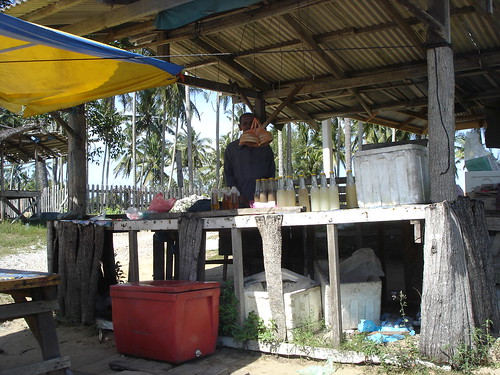
I don’t like the enigmatic smile on our driver’s lips. He suddenly pulled over by a crude stall with rolls of cloudy and yellow reused bottles on wooden platform that looked more like it was being used for selling fish than drinks. Alarm bells were ringing and we wonder what he was getting us into this time.


After some exchanges of words, the owner went over to a Styrofoam box and pulled out a plastic bottle that was swimming in iced water. He triumphantly brought back the bottle to the car and said – “Air Nira to drive away the heat!” (‘Air’ is water in Malaysia. We did not get that wrong for we pronounced it as ‘ai-year’ not air).

We looked suspiciously at that milky water, cloudy is a better description as the connotation was more accurate. Unscrewed the cap and whiff! Whew! A sweet pungent smell invaded our nose like a rotting fruit. Surely we are not going to drink that. Phua nodded his head encouragingly and poured a gulp down his throat and declared ‘great’ to encourage the rest of us who were pulling our lips down in disgust.


But we only pass this way but once and we cannot be wondering the rest of our life what that awful drink that tasted so sweet to others really tasted like to us. So we tried to prevent our nose from smelling while taking a gulp. The liquid coursed down our throat in a refreshing stream that was invigorating fresh. The taste is pleasantly sweet. In fact, everything is just great except for the smell which spoiled it for us. As this thought went through my mind, I suddenly realized – wasn’t that very much how durian would feel like to Westerners who don’t have the nose for it?


Air Nira is collected from the cut flowers of palm trees. When it is first collected, there is no alcohol content and little odor. But they fermented very fast from the natural yeast in the air. They have to be cooled immediately to slow down the fermentation. It is said either a little lime or a piece of “kulit gelam” (bark of “Cengal” tree) would also slow down fermentation. If left to ferment, within 2 hours it will turn into toddy or palm wine containing up to 4% alcohol and is intoxicating. So while Air Nira is okay for Muslim,Toddy is not so they have to be careful when they are drinking it!


Air Nira can be produced from most trees of the palm family. We assumed the one we were drinking from was from coconut. But you could also buy Air Nira Nipah which is produced from the Nipah palm. It could even be produced from the oil palm though I have not heard of anyone doing that in Malaysia. It is however very common in Africa.
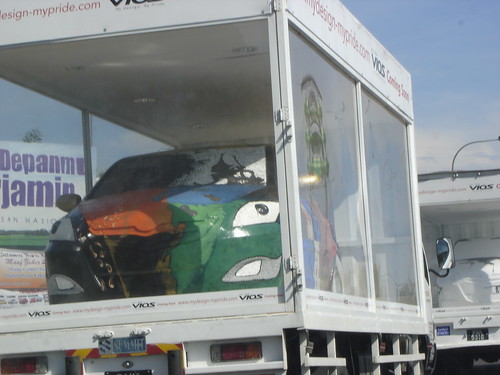


We were wondering if the Air Nira has been kept too long when we saw a car with eyes staring at us from the back of a truck pulling it. It turned out to be a marketing gimmick by Toyota on their new Vios. We heaved a sigh of relief that we would not be pulled over for drunk driving so speeded onward…

To be continued...

Friday, December 28, 2007

JJCM in KT #15 - Satar Delight!


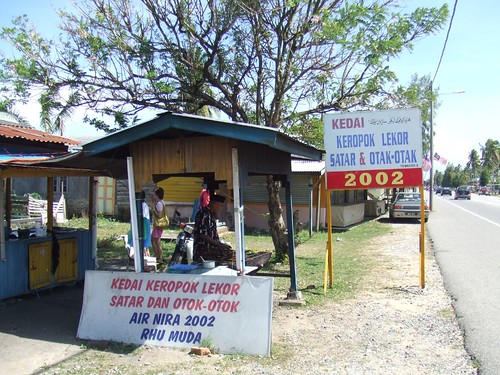
After a friend told me that Sata or Satar (seems to have 2 different spellings) is a must-try, we were on the look out for it. We decided to pick this shop on our trip back.


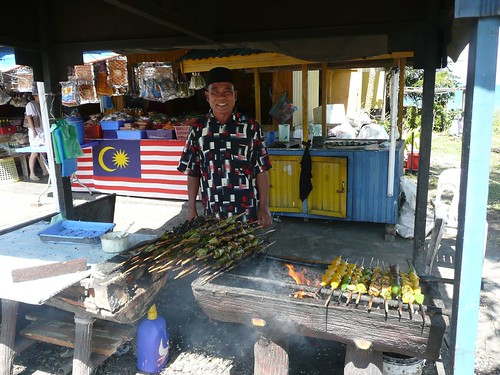
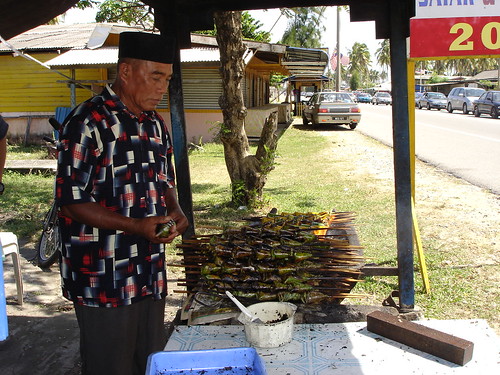
It is run by this friendly Pak Cik (they are all friendly) who also sells Keropok Lekor, Otak-Otak and other local delicacies. Mak Cik is manning the store at the back.


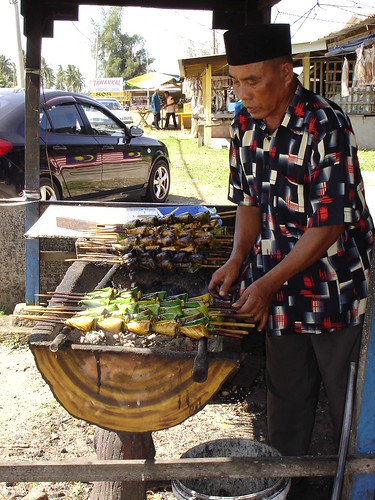
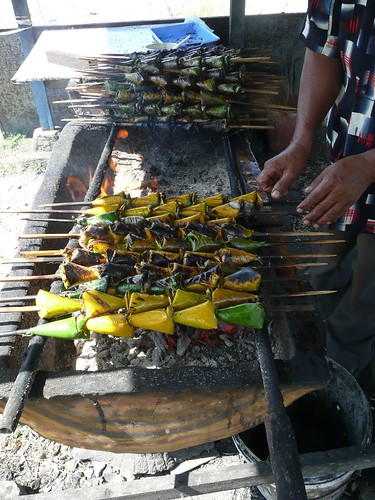
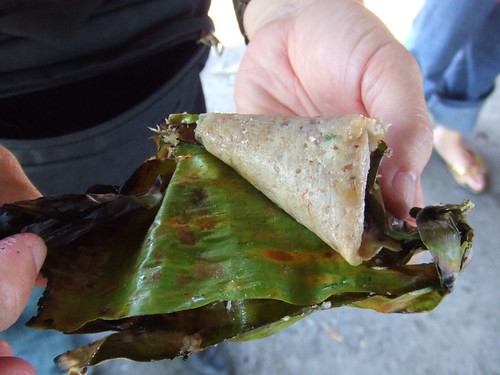
The Pak Cik was kind to explain to me that the Satar was made from 10 ingredients. Boneless fish meat, shallots. chilies, onions, eggs and gingers are pounded together into a paste, combined with young coconut and left marinated with other spices. These are individually wrapped in banana leaves in a triangular shape.


A long thin rod with a sharpened end is used to string through 5 of them to a stick. They are them grilled over a low flaming charcoal fire. They are turned over regularly until they are cooked.


The resultant combination is an excellent succulently rich tasting food that is difficult to describe. It has a mild pleasant fish flavor tempered by spices, fired by ginger and chilly, sweetened by the young coconut meat and onion to which is impacted the delicate flavor of the banana leave. The texture is soft and yet not sticky with the slightly crunchy bite of coconut meat. All in, a delicious delight. And at RM1.00 a stick or RM0.20 a piece, it is cheap! cheap! cheap!


So if you happened to be in Terengganu, do pull your car over by one of the numerous Satar stalls and have a bite. You won’t regret it. Ighosts says so.


To be continued...

Wednesday, December 26, 2007

JJCM in KT #14 - Pantai Chendering


Further down the road, about 6 km away from Kuala Terengganu is Chendering – the site of the Malaysian Handicraft Centre. This centre offers a wide variety of Malaysian handicraft and also a chance to see how these handicrafts are made. Cendering is also the site of a national deep sea fishing project with a long jetty that is excellent for fishing. These we heard about but knew we did not have the time to make a stop. There are just too many things to see and the days are too short.


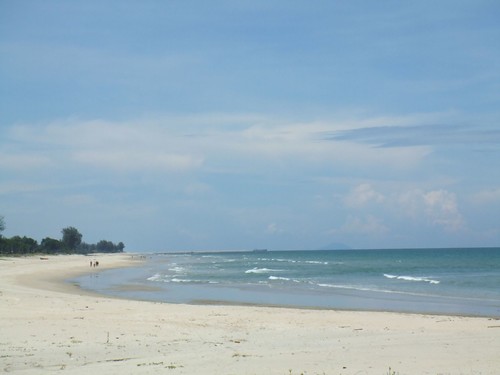
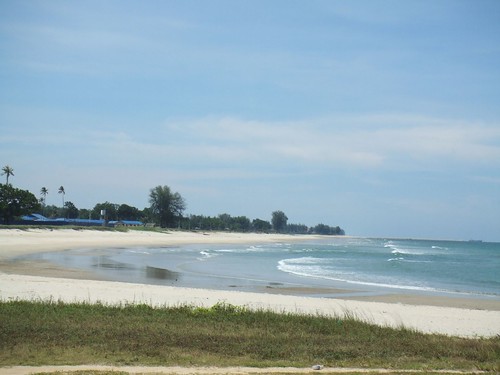
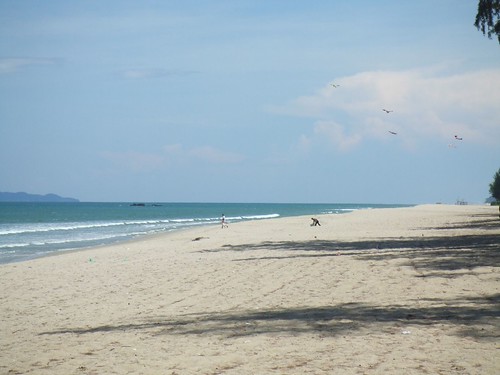
So we stop instead at Pantai Chendering which is about 10 km away from kuala Terengganu town. It is a bay with a very wide sandy beach. There is a fishing village at one end. We would love to check it out but again time did not permit. The wide sandy beach and the gentle slope made this stretch looked very inviting but it is also quite treacherous as the undercurrent is very strong.


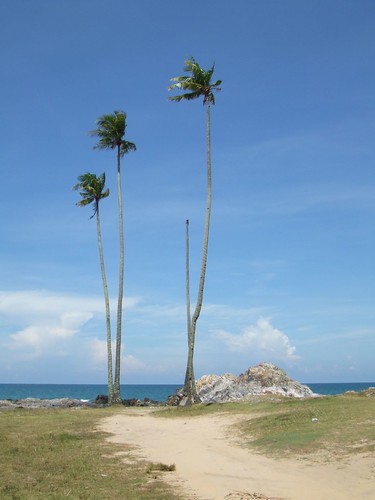
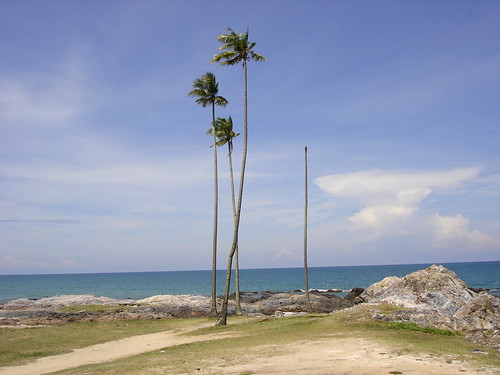
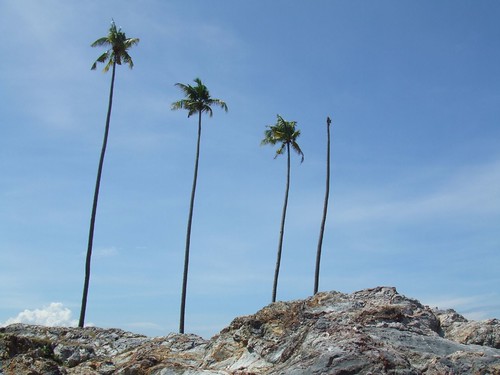
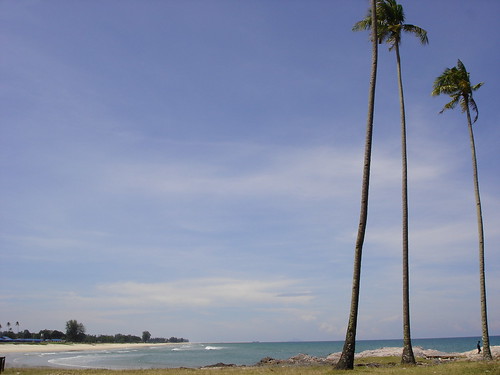
At one end of the beach, it ended in rocks and that is where I will find them. I loved these few very tall coconut trees swaying under the strong breeze. I had been here before and I always looked forward to seeing those coconut trees again. But I sadly noted that one of the trees has lost its crown and only its trunk is left standing. It will stand there much longer and I fear the other trees will also die out not too far into the future. That is a real pity for the trees added so much to the empty beach. I was shocked when I came across an older photograph recently that showed nine coconut trees where now only three still stands. If the tourism officers are doing their job, they ought to be planting some new trees here.


I loved them so much that I shot them from different angles to remember them in case they are gone by the time I got there again. If you go to Kuala Terengganu, do stop by Pantai Chendering and see those trees before they are gone. How many decades they must have stood there facing the South China Sea. I will miss them. I wonder if I am the only one who will?


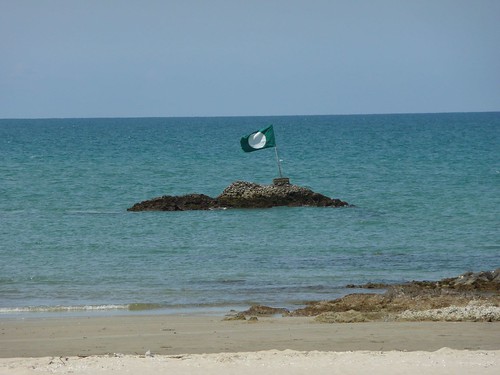
Everywhere you went, you can see huge Pas flags. Some with one moon like this one, some with two, four and more. I am not political and they don’t bother me. However, I think planting them on rocks and islands everywhere spoilt the natural beauty. There ought to be some places where politics do not intrude. There are better ways to make a statement.


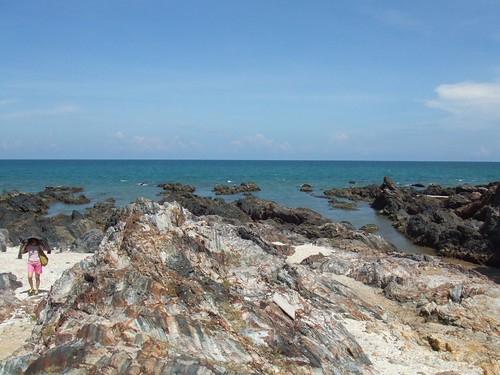
The sun was blazing hot that afternoon and there were no shades on the beach. But among these rocks are trapped colorful stones, sea shells and broken shells of crustaceans. If not for the hot sun, looking for stones or shells among the rocks can be a lot of fun. I took back a number of these small rocks for souvenirs. Free gifts from nature. I once even took back sand from Pulau Redang.


As we left, we saw this recently expired colorful crab among the white broken shells and grey rocks. Its sad end is an ominous sign. Somehow I don’t think I will see those swaying coconut trees again.


Sunday, December 23, 2007

JJCM in KT #13 - Pantai Batu Buruk / Beach Of Ugly Stone


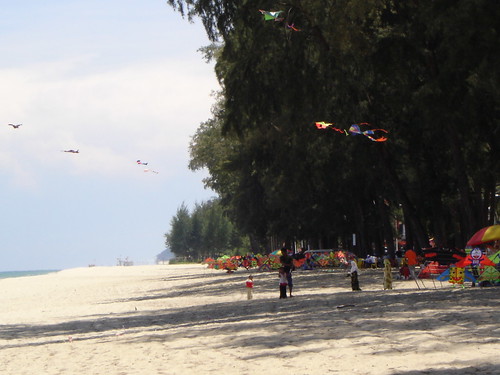
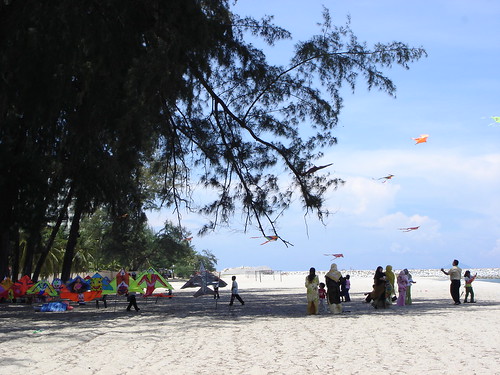
The first beach we stopped at on our way back home is Pantai Batu Buruk or Beach of Ugly Stone just a few km away from Kuala Terengganu. We wonder how it got its name for though hard I looked, I could not see any ugly stone just miles of sandy beach. There was a strong wind blowing and the Casuarinas trees that lined the beach giving it shades bend and sway to it. This is an ideal weather to fly kites.


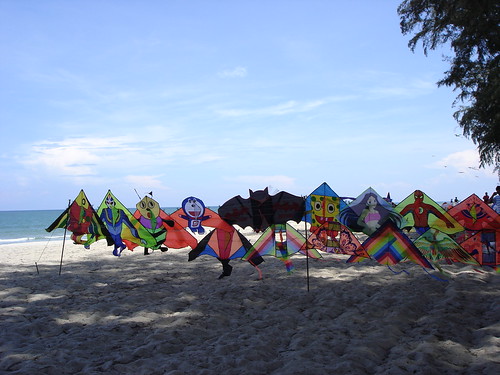
There are many kites for sales mostly drawn after cartoon characters such as Batman, Spiderman, Doraemon, Ultraman, SpongeBob SquarePants etc. My favorite is the demure Mermaid. These are the simpler kites suitable for the families. Those who flies more elaborate kites brought it themselves.


Malaysia also has kites that are uniquely hers which she called “Wau”. There are many types of Wau, each with a distinct name. The Wau above is called Wau Bulan or Moon Wau as its tail resembles that of a crescent moon. The Wau Kuching or Cat Wau is so called because in flight, it made a humming sound like a cat. Other famous categories are Wau Barat (Leaf Wau or Morning Wau), Wau Merak (Peacock Wau) and Wau Jala Budi (Woman Wau).


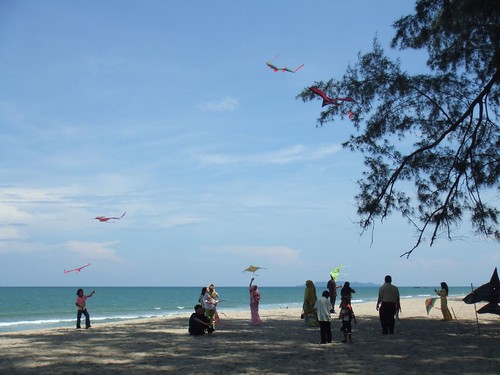
Under the shades of the Casuarinas trees and a strong steady wind, the kite fliers are really enjoying themselves.


It is such a pleasure to watch whole family get together to enjoy the activity.

There is something very soothing about watching kites fly.


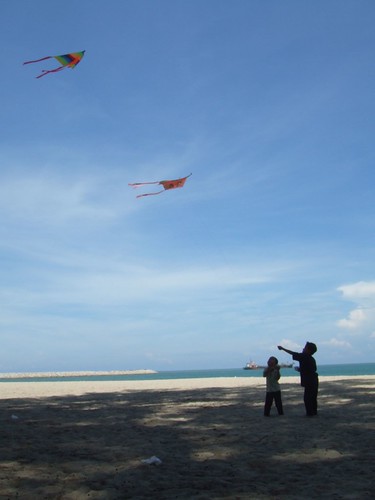
A small boy and his brother flying their kites.


Pantai Batu Buruk is also famous for their hawkers stall besides being an ideal place for kite flying. The water is a bit too dangerous for swimming. The food stalls served a diverse varieties of food ranging from Nasi Dagang (Terengganu traditional rice), Yunnan chicken rice to fried ice cream. We unfortunately too full to check them out.


If you happen to be there on Friday, you should visit the “Friday Market” which have many additional stalls selling shoes, clothing, toys, handicrafts, souvenirs, fruits, foods, daily products, practically everything you can think of. There is also a cultural centre located here that put on stage performance on Fridays from 5.00pm to 6.30pm. The performance includes Malay martial art “Silat”, kite flying, sepak raga (a rattan ball game) and top spinning.


At that time when we were there, I heard the name of the beach wrongly and thought it was Pantai Batu Busuk or Beach Of Smelly Rock. As we drove away, we suddenly got a strong whiff of bad smell. I thought then that must be why they named the beach so. But for some reasons, all my co-travelers all pointed the finger at me. I still maintain that there are only 5 suspects – my four fellow travelers and the beach. That is the beauty of writing a blog, it gave you the last say, ha ha. No comment accepted from my fellow travelers, please. :-)


Friday, December 21, 2007

JJCM in KT #12 - In The Market - Part II


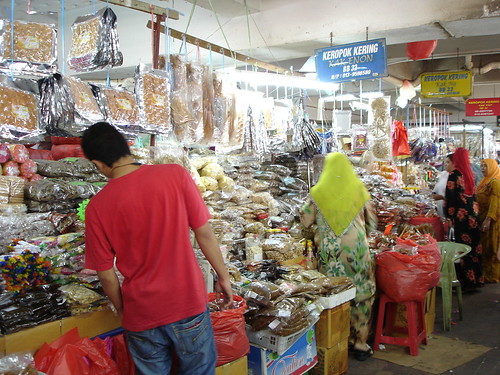
In spite of this being the second day of Hari Raya, some stalls were still opened for business. When I asked one of the proprietor why he did not rest, he gave me a very good answer – “if all the stalls were to close, where would the outstation travelers buy their goods?” Many visitors came here to buy the local delicacies to take back for their friends and families. It is a ritual that almost all visitors to the East Coast will do. He said he can rest when the other stall owners come back. There proved that myth wrong again.


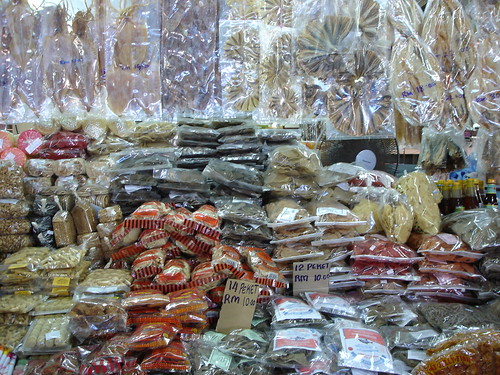
The most popular take-away are products of the sea – dried squid, dried fish snacks, salted fish, keropok kering, anchovies, dried prawns etc that came in all shapes, sizes, colors, flavors, and varieties.


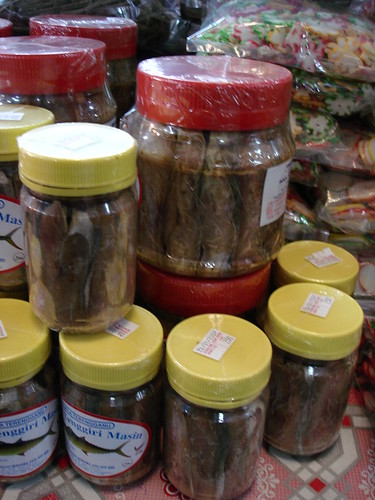
This is preserved fish in brine packed in plastic containers. There are concerns about whether this food is healthy. The colored discs at the back are crackers that need frying before they can be consumed.


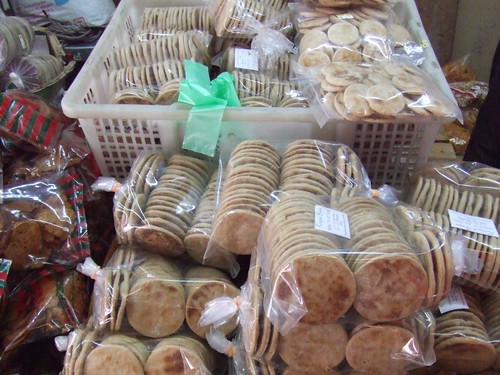
These are biscuits made from sago starches. Sago starch is produced from the pith from inside the Sago Palm. The sago biscuits have a very ‘short’ texture and breaks and sort of melt in your mouth. It is quite sweet and have the strong flagrance of ‘santan’ (coconut milk).


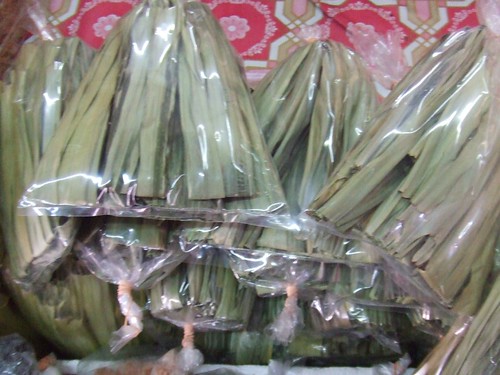
These are ‘dodol’, a popular Malaysian delicacy that is a sweet, thick and sticky glob that is made from palm sugar, coconut milk, rice flour and flavored with pandan. The packing here is more unusual as they are individually packed in palm leaves.


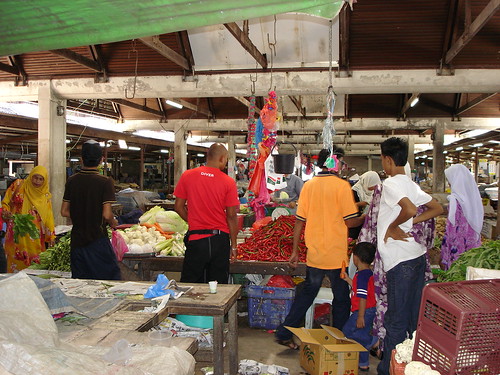
Most of the stalls in the wet market sections are closed. This one which stayed opened did a roaring business as there was little competition. Wonder if the price is increased because of the extra service? I was sad when I passed one stall that openly sells sea turtle eggs. Until today, the authority has not been able to educate the consumers/traders or to eradicate this practice. It is not that the eggs can fetch high prices. The kick-back from tourism would have been much higher. I felt that the government ought to do more to stop this though it is probably too late by now with much of the turtle population decimated.


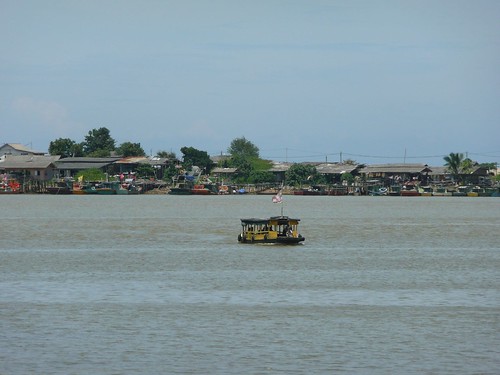
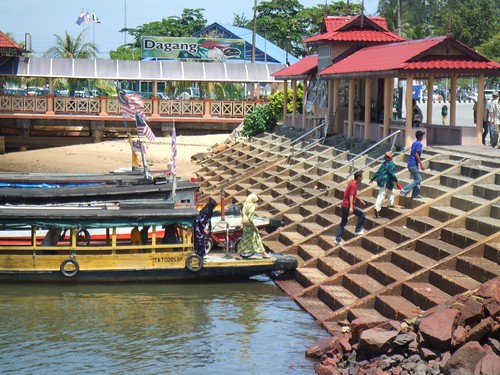
The market is built on the bank of a river. There are village along the whole stretches of the river. Traveling through and fro both banks are faster by river ferry.


A river ferry slowing down to dock at the ferry terminal.


But no, it is easier to just dock by the river bank.


We have now bought enough souvenirs for our friends back home. With that errant done, we are now ready to depart Kuala Terengganu for home. But our adventure did not end here. Follow us as we take you to three beaches and two new foods on our return journey.


Wednesday, December 19, 2007

JJCM in KT #11 - In The Market - Part I


We decided to make a stop at the market in Kuala Terengganu as the food market is always one of the most interesting place of visit. There was a brand new building opposite the market. We are not sure what it is but the local architecture sure looks imposing and beautiful against the blue sky.


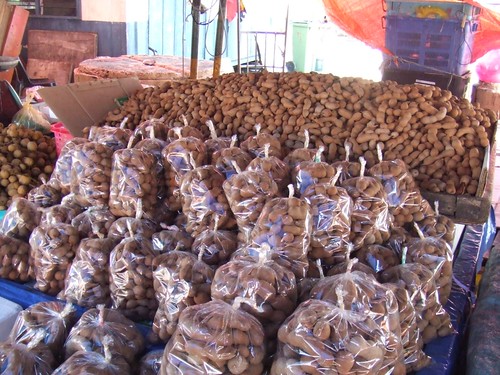
The first stall we came across was one selling tamarind pods. We eagerly bought some only to find later that stalls inside the market was selling at significantly lower prices. We did not follow the advice of not buying from the first stall you came across until you had checked the prices.


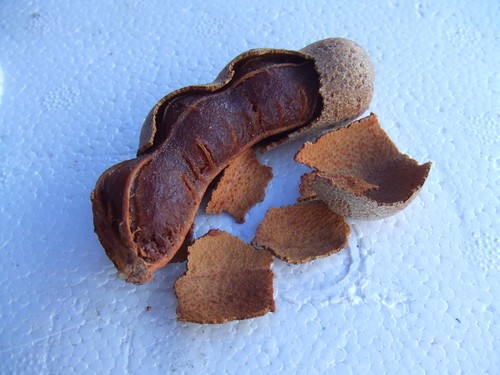
This is what the inside looks like, each segment of the pod contained a seed linked by fleshy meat that tasted both tart and sourish. Not my favorite but the ladies seem to take a liking for them. However, they are great as a spice and can be used to produce some of my favorite dishes – Asam Fish and Asam Prawn. I remembered once I had a lovely Asam Crab in Vietnam too.


A Tamarind tree can be very tall rising above 20m. Tamarind wood has a bold red color and due to its denseness and durability is used to make furniture and wood flooring. Its branch is sometimes used to make a Tamarind switch for corporal punishment – ouch!


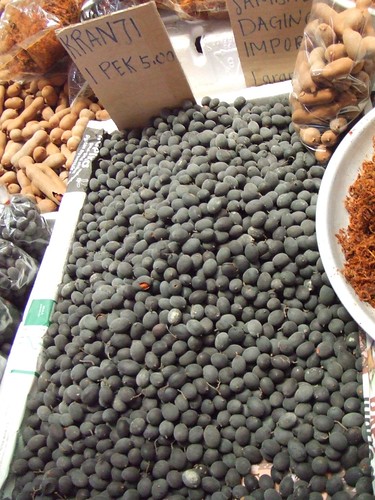
These grape like looking fruits are called Kranji or Keranji. It has a hard black brittle shell and dark brown meat surrounding a flat seed. It tasted somewhat like a Tamarind hence its English name – Velvet Tamarind. It is never a cultivated plant because it has a very long juvenile period before flowering, as long as 15 years. Its hard compact wood is highly prized thus leading it being logged. The tree is threatened species. The Thais dried the fruit and add sugar and chilly to make it into a fruit candy.

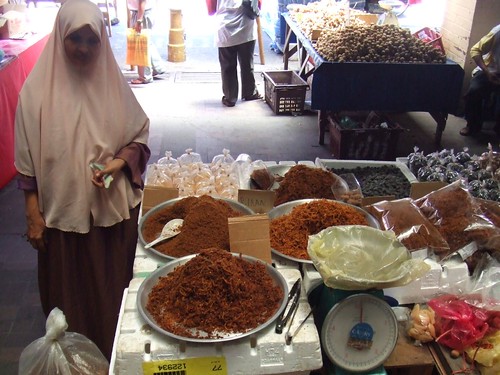
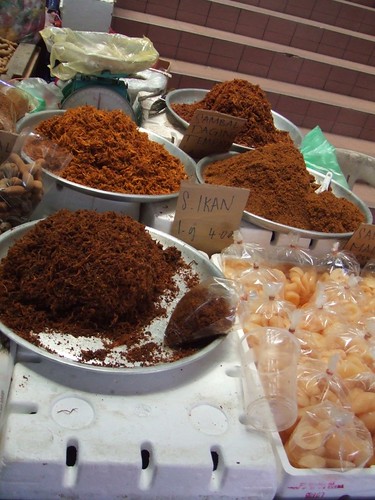
Many types of meat floss are being sold in the market especially from chicken and beef. They are produced in different texture – powder, strings, lumps etc.


The light orange fruits in small plastic bags at the right-hand bottom of the picture are honey salak. I have never eaten salak in this form having always eaten them fresh. I now regret I did not try it then for I will always be wondering what they taste like.


Source: Wikipedia


The fruit is called snake skin fruit in English because the scale like skin resemble that of a reptilian skin. The hard leathery skin is misleading for it pealed quite easily. Inside are three lobes that looked like giant garlic with a hard seed in the center. The original fruit’s taste is relatively mild with a sourish tinge and a nice aromatic flavor. The texture is very crunchy. It is quite different from other fruits. It is difficult to find really good fruits but I liked it quite a lot when I come across a good one. My experience range from very sourish I had in Phuket, slightly flat in Surabaya to the best I had – sweet, slightly sourish and aromatic in Bali.


These fruits are seldom sold in the average market in the Central region. We walked further into the market looking for more discoveries.


Saturday, December 15, 2007

JJCM in KT #10 - We Ate Dog Shit Instead.


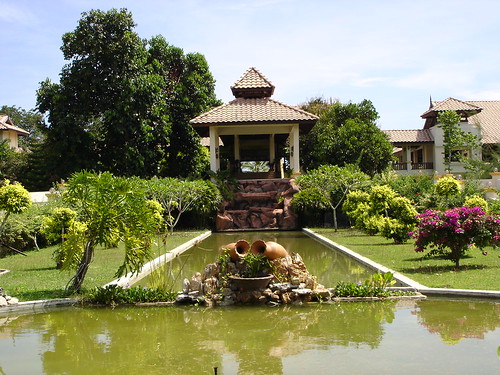
After that heavy breakfast and no duck shit, we got ready to leave the hotel to make our way back home. This is the front approach to the hotel. No, you are not expected to walk on water though it looked like it.

Phua asked “Are you ready to try ‘kao sai’ (hokkien dialect – dog shit) now?”

“What!?”


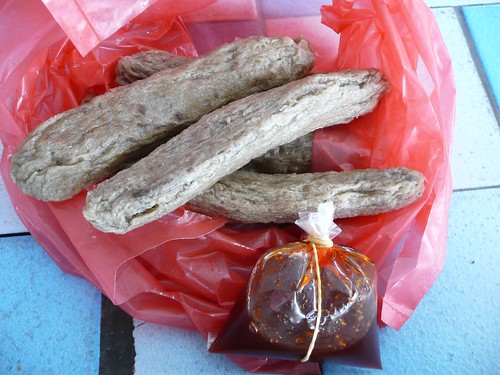
The local Chinese affectionately called ‘Keropok Lekor’ or also known as Terengganu sausage ‘kao sai’ or dog shit. It did not need a lot imagination to know the reason why looking at the above picture. It was meant to be playful for the Chinese ate this Malay food with as much relish. It made the food ‘colorful’ and we had fun kidding each other about eating dog shit. Malaysians do have a warp sense of humor and it did not destroy our appetite in any way. Don't let their looks fool you, they are great tasting.


It is eaten with the local chilly which is sweeter than hot. Though keropok lekor is sold throughout Malaysia, Terengganu is famous their quality. That is because with a thriving fishing community, the keropok here contains higher amount of fish paste and thus can be deemed more ‘genuine’. The fishy taste is much stronger. Also they used sago instead of wheat flour as the binder. Thus, this version is much darker in appearance than the West Malaysian version.


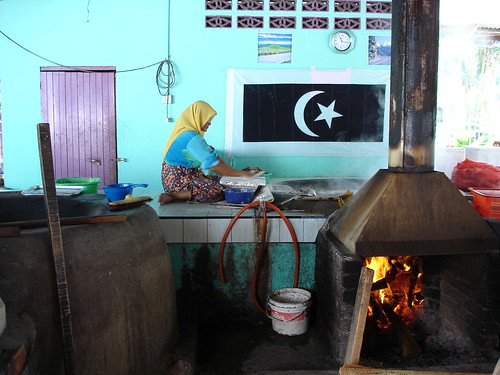
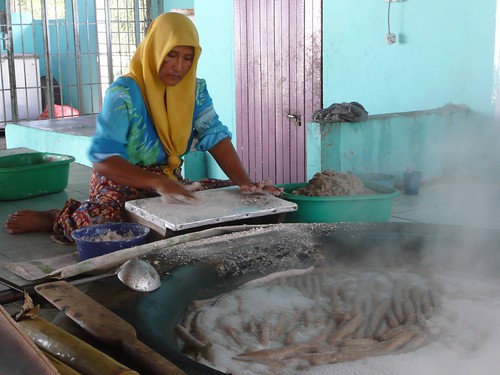
Minced fish meat usually from ‘Ikan Parang’ and ‘Ikan Kembong’ are stirred with sago flour, water and salt to a soft dough. Terengganu keropok lekor are very rich containing than 50% fish meat.


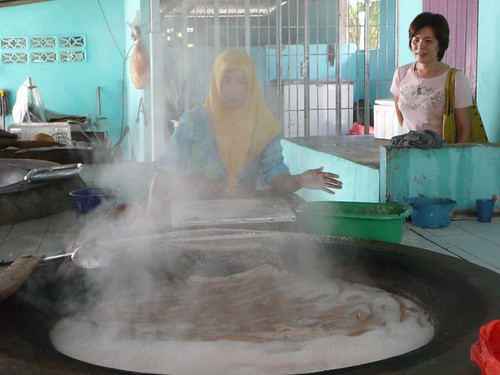
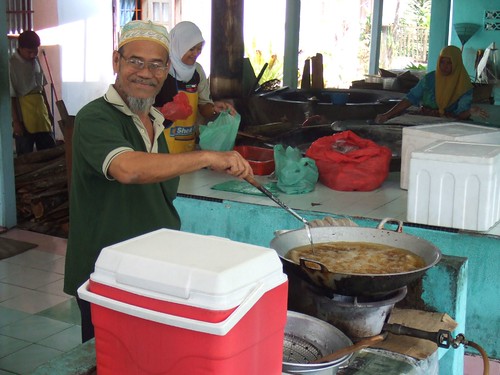
These are rolled with sago flour into long hot dog shape and directly into a large boiling cauldron. Notice the dough mass in the green pail waiting to be rolled.


The dough will sink to the bottom. When they float, they are ready to be fish out, cooled and consumed. The boiled version is best kept for less than a day before consumption and is also fishier in taste. But they can be taken home and further cooked with other ingredients or refrigerated and fried when needed.


Or you can buy the fried version. However, this is best consumed fresh. If you refry it to heat it up again, it is too hard and leathery. I asked this Pak Cik (uncle) to smile for the camera. He smiled with a few teeth missing and said “I could give you a really handsome smile when young but now I am old”. He then gamely closed his mouth and smiled for the camera. The people from the East are very friendly and contrary to the myth, hard-working. This is the second day of their new year and he said “Well, what use is it for me whiling away my time at home?”


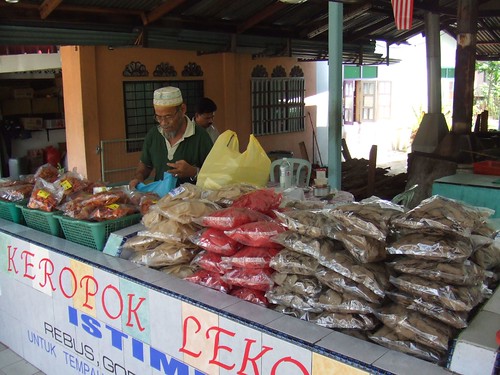
This Pak Cik’s shop also sell Keropok Kering (Sliced Keropok). These are much larger diameter keropok and sliced thinly. These sliced pieces are then sun-dried making them shelf stable. You will have to fried them when you want to eat and they will puff up nicely for a great snack.


We had our dog shit and enjoyed it. We bade farewell to the Pak Cik and continued our journey home.

To be continued...

Tuesday, December 11, 2007

JJCM in KT #9 - Searching For Duck Shit In Terengganu.


Before we leave for Terengganu, a friend told me to try “kuih tahi itik” (translated as duck’s dropping cake or more crudely – duck shit) and Satar. So I asked my Terengganu friend to describe what this famous duck shit is. His description was as vague as the shape of the cake serving to make me “curiouser and curiouser” to try this cake with the “pelik” (strange) name.

On the morning of the second day, Phua bought us a sumptuous breakfast consisting of typical Terengganunese fares.


From top left to right: Roti Paung Butter, Kuih Kosui, Kuih Keladi (yam cake)
From bottom left to right: Kuih Seri Muka, Roti Paung Ikan, Pulut Lepa


My knowledge of Malay cakes is not so good so if I make any mistakes, appreciate a correction. Roti Paung are sweet buns that are baked in a metal plate. The buns at the top of the picture have butter or margarine as the filling while those at the bottom buns used mashed fish. The fishy taste is very strong and a bit too strong for our mild West Malaysian palate. You can see a picture of how they are made in the picture below.


The green cake is kuih kosui pandan and the white stuffs at the top are coconut shavings which we sprinkled and eat together with the cake. Kuih Keladi or yam cake with the packet of chilli sauce is a popular Chinese breakfast meal.


The brown cake at the bottom left is kuih Seri Muka which composed of two layers, a savory lower layer of glutinous rice and a sweet creamy top layer made from egg and coconut milk more commonly colored green. The contrast in both taste and texture made for a very interesting combination. The cake at the extreme right is pulut lepa which is also made of glutinous rice with a filling of boiled fish meat is mixed with sliced onions, and dried chilies and coconut wrapped in a banana leaf.


We had them all for breakfast. They were good but we did not find our duck shit even though we asked from a number of stalls. We were told they were more a Kelatanese food and that it is more difficult to find now because the fasting month is over and also many stalls were still shut.


After we returned, I was still haunted by duck droppings. I spent almost a whole morning searching for it but I could not find any site with a picture of it till I struck the mother lode when I stumbled on Ray Kinzoku’s site (which is one of the best Malaysian blogs I ever came across – check it out). The information below was extracted from his blog -


Originally uploaded by Ray Kinzoku.


(Clockwise from top ( 12 o'clock ): Pauh Llayae ( at a glance, looks like a slice of bread immersed in syrup - so far, I only know one who could prepare it - Nik Yae ), Piyana ( muffin-like, light brown in colour ), Akok Nnissae ( wrinkled, brownish figure ), Akok Pandae ( wrinkled, greenish figure ), Buwoh Tanjung ( teardrop shape ), and Jalor Mah ( yellowish "golden" strands ). The white blob in the middle is Putih Telur or famously known as Tahi Itik.”)


There, now you know what duck shit looks like. Its shape is irregular like duck’s droppings but I still do not know what it tastes like. But in searching for one cake, I found many more waiting to be discovered – that is life, I guess. Maybe I should be planning for a trip to Kelantan next. Ray, care to be our guide? :)


To be continued...

Sunday, December 9, 2007

JJCM in KT #8 – The Morning In Picture II


Firework Bloom


Spider Lilies


Together we bloom
Together we die
What a life!


Too good to eat


Jewels in the sky


Hibiscus in delicate white


A broken spider web (contribution from June)


Giant spiky (contribution from June)


I came from humble parentage


Caught! (contribution from June)


Saturday, December 8, 2007

JJCM in KT #7 – The Morning In Picture I


Morning call


Sun on balcony I


Sun on balcony II


Sun on balcony III


Peep


Feather Duster


Thorns & Flowers


Hanging Garden


Fly


To be Continued...

Tuesday, December 4, 2007

JJCM in KT #6 – Onward To Kuala Terengganu.


The car felt heavier with all those food we consumed. The road we were traveling on hugged the coastline and at certain stretches there were unobstructed views of the sea. Coconut trees lining the road gave a rustic feel but we noted dying coconut trees losing their crowns. The East Coast without ample coconut trees would look like a sad lady shorn of her hair.


Life is carefree but sometimes you don’t know whether to be envious or horrified. Like this underage boy on the motorbike with only slippers and no helmet. He grinned at me, eyes hidden by huge sun glasses. I have seen up to five on a motorbike, a parent with 3 small kids sandwiched together. While we are alarmed at the danger, would we have done the same in their situation?


By 2.00 pm, we reached Teluk Ibai, just 4 km away from our destination – Kuala Terengganu. We stopped there to visit the famous Tengku Tengah Zaharah Mosque also known as the “floating mosque” (Masjid Terapung). The architect is relatively simple and clean cut but beautiful. The white building under a blue sky and fluffy clouds reflecting on the calm water of the surrounding lake evoke a pleasing serenity. This was further enhanced by the sea breeze of the South China Sea at the backdrop. Time slowed down to match the feel.


We reached Phua’s house by 3.30 pm and his niece took an interest in us. We chatted with his parents who showed us very interesting old sepia photographs of their school days. Well mannered girls in black and white uniform, teachers with their bouffant hair style and 60s clothing lining up under fern trees in front of their wooden school building standing on concrete legs. We were treated to home brewed tea prepared from wild sugarcane. A delicious curry chicken and rice was served with “Acar” (a spicy, sweet and slightly tangy vegetable salad). More food but how could we refuse?


We reached out hotel – Gem Beach Resort (RM160.00 per night) in Batu Rakit by late afternoon and of course the first thing we noticed is the lazy chairs under the coconut trees facing the sea. It is inviting but we decided to take a rest first and wait for the sun to go down a bit.


Our rooms have balconies where we relaxed, chatted and ate the snacks we brought along. I know, still eating.


There are plenty of luxuriant plants especially bougainvillea giving it a hanging garden feel.


What is this lonely boat doing out there in the open sea?


Towards evening, we headed for the beach. The oppressive heat has by now given way to cool evening breeze and it was very pleasant walking along the beach.


As the evening deepened with the sinking sun, the sky gave a wonderful display of color. We are pleased with the fact that the beach is so deserted. The Malay New Year celebration must have something to do with it. After many years of traveling, I often treasure quiet moment more than hectic ones rushing around to take in more of everything.


A tender moment shared between father and son.


The waves and undercurrent are very strong on the East Coast and many inexperienced swimmers have got into difficulties here. As I stood on the sand, I could feel the waves pulled them away from under my feet.


The lights came out.


Enough time has passed by now for us to be hungry again so we drove out to Kuala Terengganu’s Chinatown.


In the restaurant named Golden Dragon, we ordered (from top clockwise) steamed Garuba fish, 5 spices meat rolls, Xing Jiang bean curd, bitter gourd fried with roasted pork. Unfortunately, they ran out of all the soups that night so we did not get our lotus root soup.


It had been a long day. After the heavy meal, we were ready for bed thus ending the first day of our road trip to Kuala Terengganu. We have seen and savored much during the 500 km journey. It had been lovely so far. Tomorrow promises more.


To be continued...