Friday, February 29, 2008

Port Klang Views #5 - Up The Mouth Of Klang River.


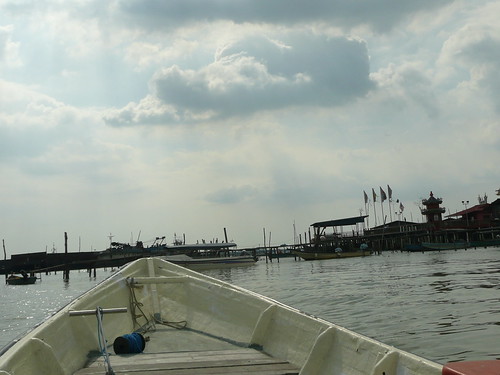
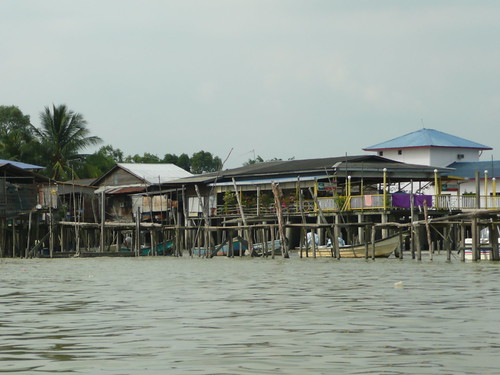
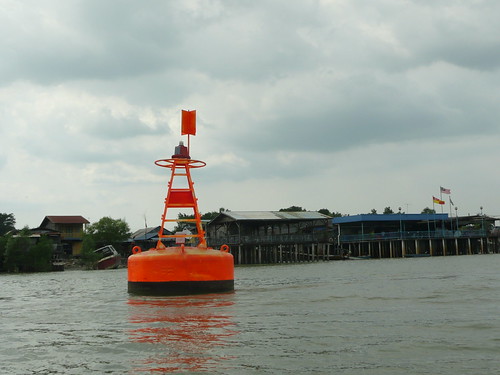
There are brightly colored buoy to mark shallow water of the heavily silted River Klang which opened out to the sea off Port Klang slightly further down from this point. Bagan Hailam or Hailam Village is in the background. The storm clouds continued to darken and the wind was picking up.
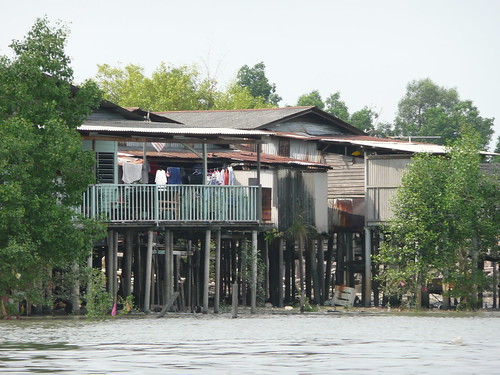

This is how the Hailam folks lived, wooden houses in stilts among mangrove trees. However, amenities are quite basic and hygienic conditions are lacking.
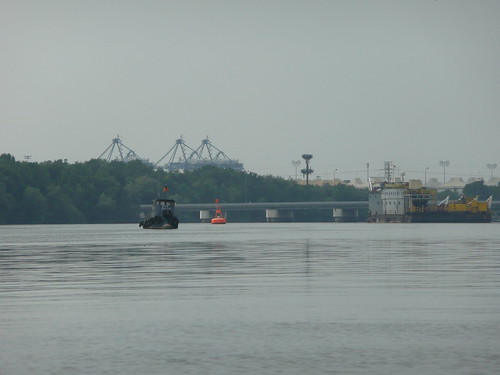

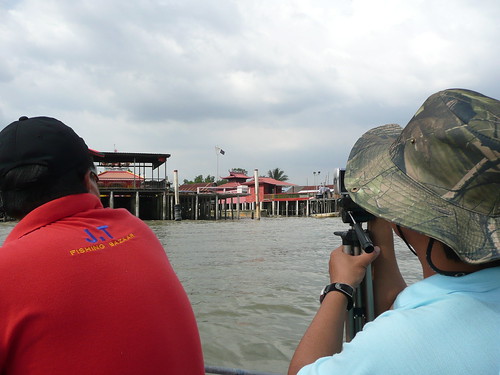
We headed towards the bridge that connects the mainland to Tanjong Harapan and North Port over the Klang River. I had fished there before as a kid and usually caught nothing except puffer fish. Still it was fun in those days with no computer games. I cycled all the way from Port Klang because all I could afford is pedal power. And I did not even have a fishing rods, just line and a hook and dead prawns stolen from the dining table.
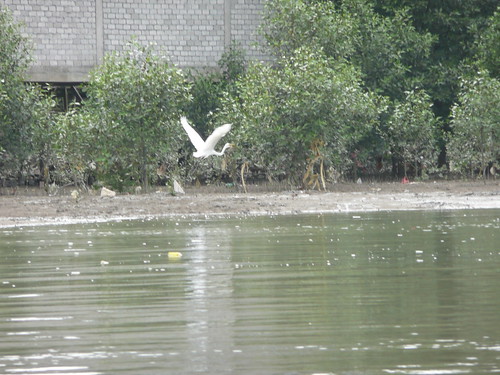

Along the way, we saw this white stork taking off in a graceful flight.
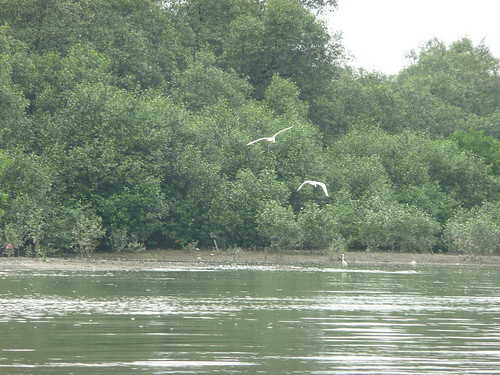

Then we saw more of its friends, some fishing among the mud, some perching on the trees. These two were gliding down to join in the fun. These storks are not from this part of the world. They are migratory birds that flew here during the winter months. Soon they will once again disappear back to where they came from. And we will miss them.
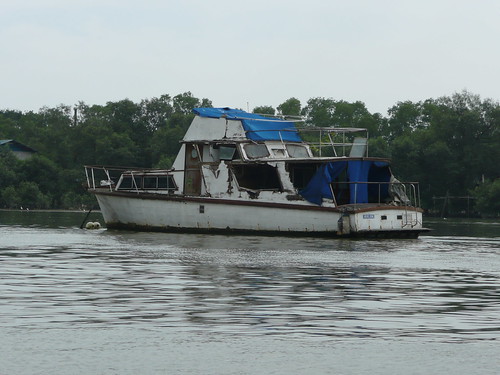

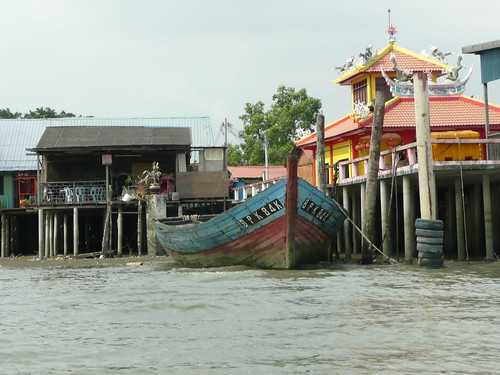
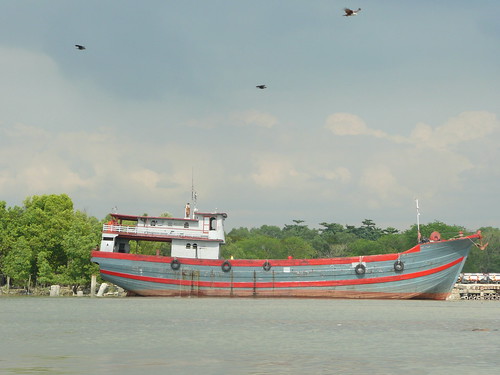
We saw this boat abandoned in the middle of the river. It must have been anchored there for some time. Wonder who owned it and why did they left it there to rot. Why don't they just scrape it? At least something can be salvaged from it.
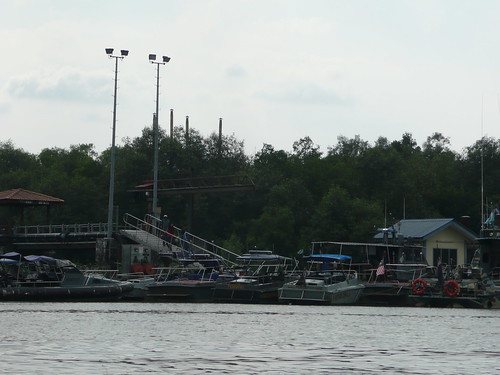

There were more docking bays for boats.
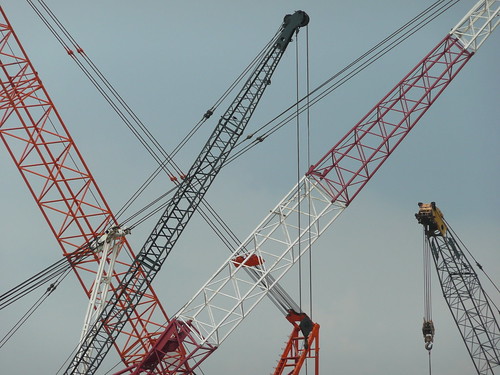

Construction cranes criss-crossing the sky.

We did not reach as far as the bridge. Just before it, we turned back and headed back to Port Klang. As we turned away from there, I noticed an interesting sight. Two crows were trailing a sea hawk as if attacking it. They then did aerial acrobatics with sometimes the hawk in front and something behind. This went on for some times. I was not sure if they were playing or who is attacking whom.

It would have been interesting to see the conclusion of their aerial dance and to see if this was indeed a play or an attack. If any bird is the aggressor, the crows look more like the aggressor than the hawk!
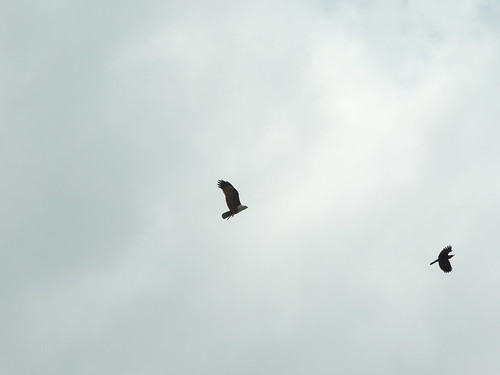

One of the reason I said that was because much later in the trip, I saw a crow actually chasing a much bigger stork. These Port Klang crows are a real terror! Klang and Port Klang are quite badly infested with these noisy but clever birds. However, because of their numbers and dirty habits of picking at rubbish, they are pretty much a nuisance. The local authorities have tried various methods but none has proved really effective against these smart birds that can sense danger, evaluate traps and loudly warned each other. If one bird is injured, all the other crows will fly around in circle above the injured bird but always out of range of the pellet guns. I had seen them taunt hunters by diving at them and then swerving away just beyond the gun's range. The hunters knowing this always work in pair with one hidden away but the crows will soon get wise to any ruse. You can fool them some of the time but you cannot fool them all the times.


To be continued...


Wednesday, February 27, 2008

Port Klang Views #4 - Bagan Hailam.


Next, we head over to Bagan Hailam or Hailam Village. This is actually not an island but more a peninsula. The other end of Bagan Hilam is an esplanade (where in the last post, the Chap Goh Meh was held) and the Port Klang Golf Resort. It is so-called because most of the inhabitants that stayed there are Hainanese. Their houses are built on stilts and their livelihood is the sea. In the old days you could get one of the old lady in the sampan to row you over to the other side from the mainland by just paying 20 cents when I was a boy. It was a very pretty sight with all these sampan rowing its way to and fro. There was no bridge connecting the river then and that was the only means of transport. That all changed when North Port was developed. Not one but two bridges were built and Tanjong Harapan was born.


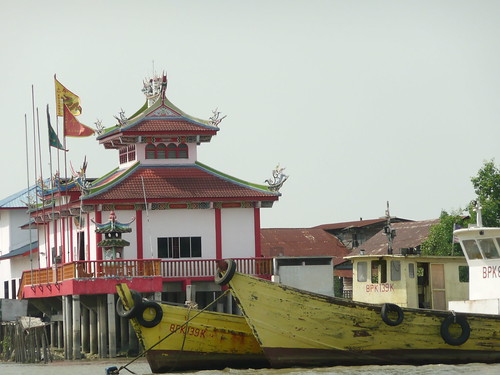
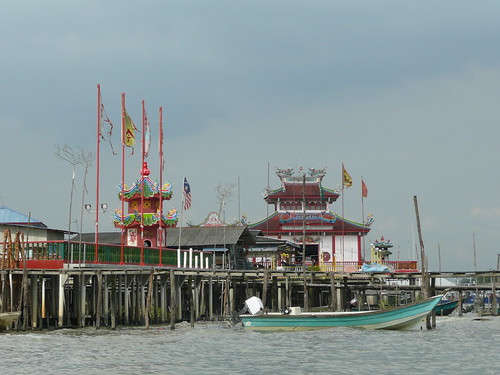
A temple on the sea. When the tide is up and the brightly colored temple seemed to floating on the water besides the boats, it is a very pretty sight. And at night when only the temple lights are visible and reflected on the ink black sea, it is really beautiful.


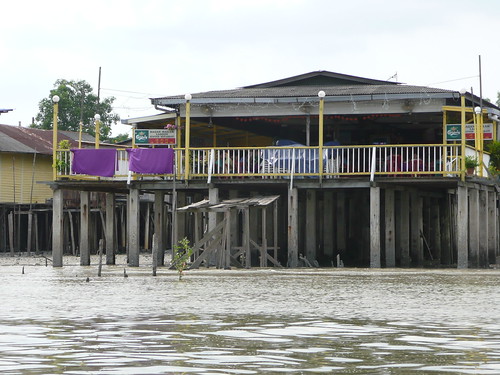
This is one of the many restaurants that lined the waterfront. This place became well known for its seafood restaurants and city folks from as far away as Kuala Lumpur will drive all the way here to savor its cooking. Today, it is not as popular as it was about 5 to 10 years back. Having your food with the sea breeze kissing you makes for good appetite.


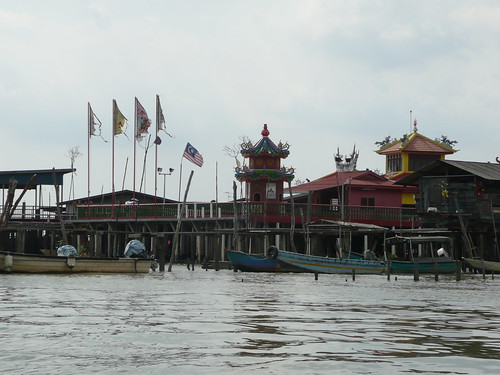
Another temple in idyllic setting. The torn temple flags fluttering in the wind.


Another seafood restaurant amid the wooden huts of the inhabitants. How would you liked to have freshly cooked food served in this setting?


We continued with our work and hope the wind will blow the clouds away from us. What do you think? Did it rain or did it not?


The view of the temples and villages from different angles from the sea.


Though it looks relatively healthy, Bagan Hailam is also a dying village as the young people moved away from the village to seek a better live. With their departure, the village is losing both its inhabitants and vibrancy. Also, development is encroaching ever nearer to the village. One day, with most of the inhabitants gone and the place too attractive for developers, this village too will be memory of past. I know it will happen. I just hope I would live to see it.


To be continued...


Monday, February 25, 2008

CNY: Chap Goh Meh #3 - Chap Goh Meh In Tanjung Harapan.


When we reached Tanjung Harapan, we were caught in very bad jam. We moved forward inch by inch and for a long period of time were at a complete standstill. The place was very crowded. How different it was from South Port where we came from.


Kurau was rightly worried about finding a parking space. I was not at all worried except getting to the center of the activities where the esplanade opened out to an observation deck and where a replica of a sailing ship was placed. Opposite this was the entrance to the Port Klang Golf Resort. Kurau’s jaw dropped when I drove straight in, the surprise in his face was priceless and almost worth the yearly subscription I paid but did not make use of.


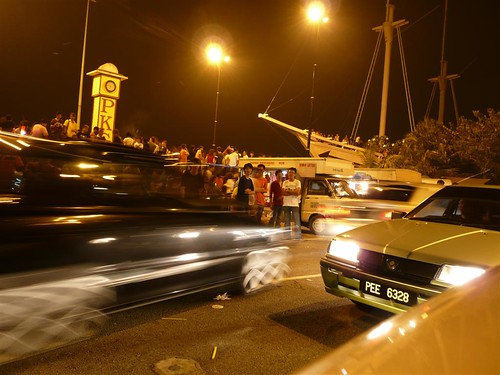
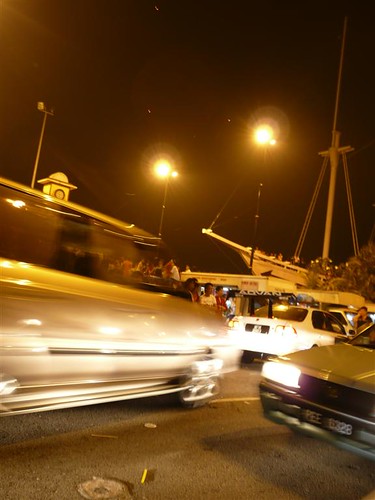
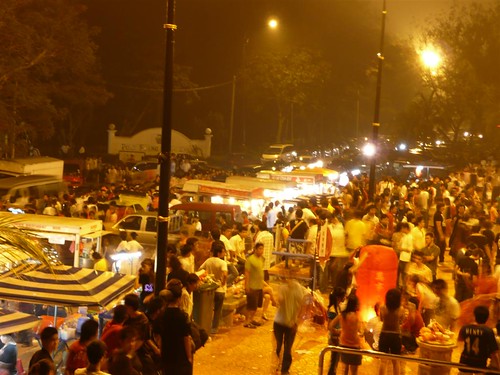
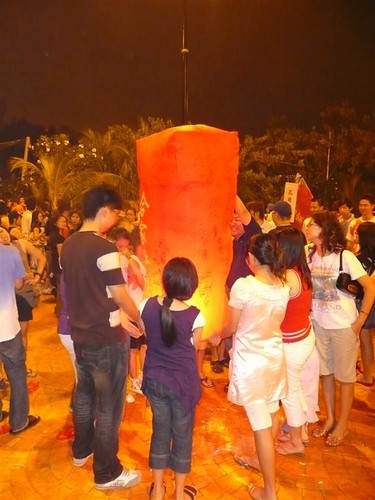
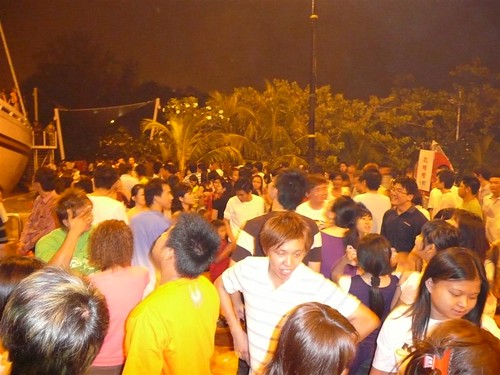
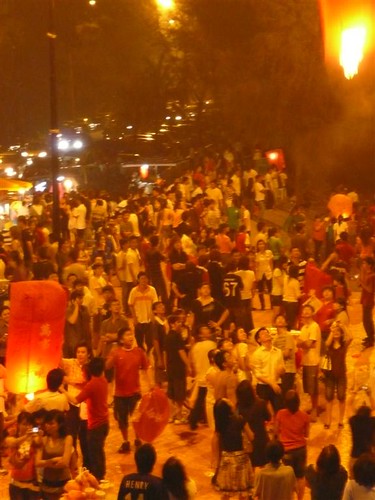
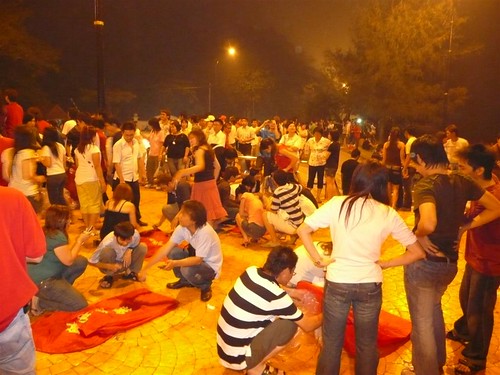
This was the riotous condition there. Cars double and triple parked. Hawkers were doing roaring business. And the huge crowd milled around, looking at people launching Kong Ming lanterns and each other. There was hardly any space to move. If this is the first place in Malaysia a foreigner was to land, he will think that the population is 99% Chinese and the average age to below 20.


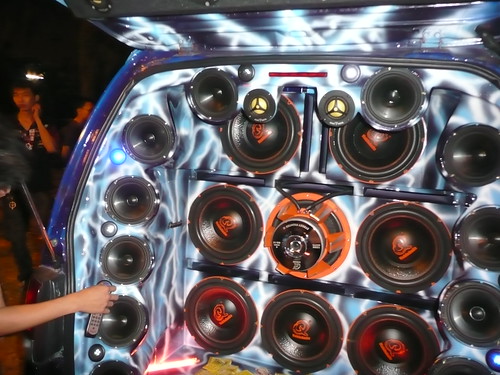
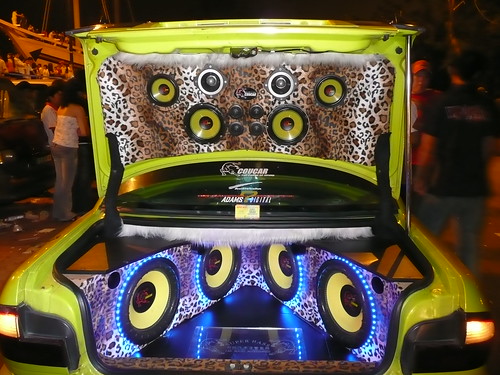
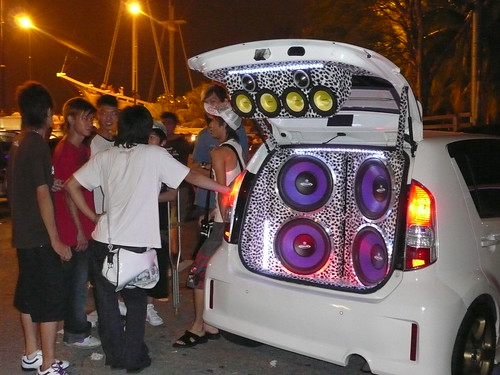
The first thing that hit us as we came out from the club was the sound war blasting on from about a dozen cars with specially soup up audio system. They were turned up at full blast and the deafening sounds were coming from all sides. The sound was so loud that they literally vibrate you. BOOM!!


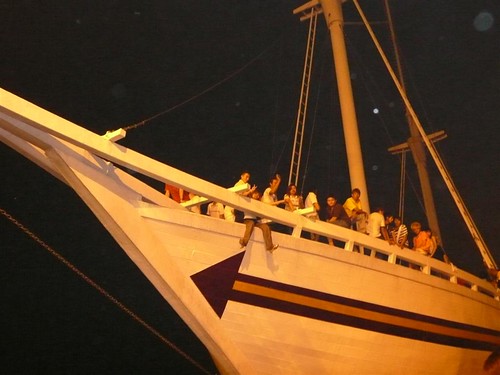
Though the entrance to this replica ship is closed at night, it did not stop the crowd from finding a way up.


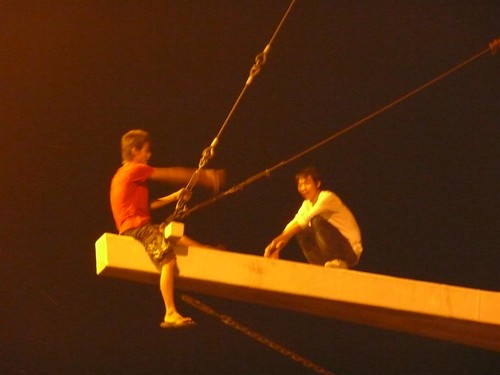
Some more mischievous chaps behaved dangerously trying to impress the girls with their antics.


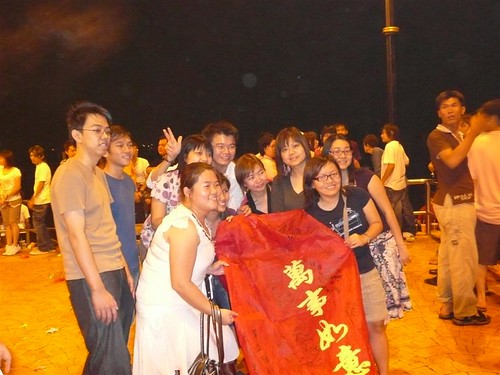
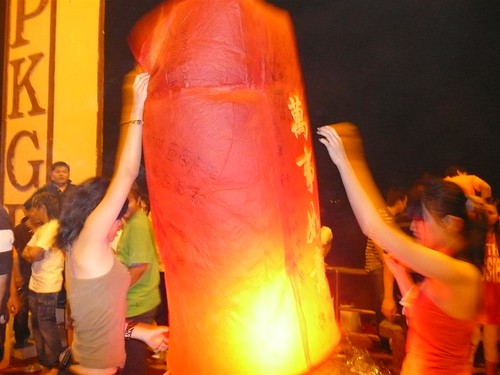
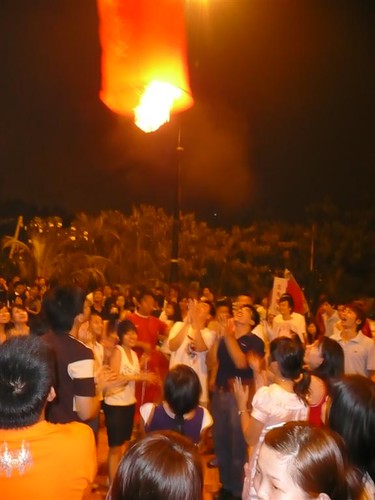
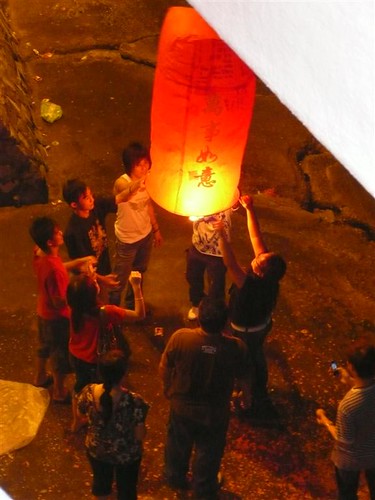
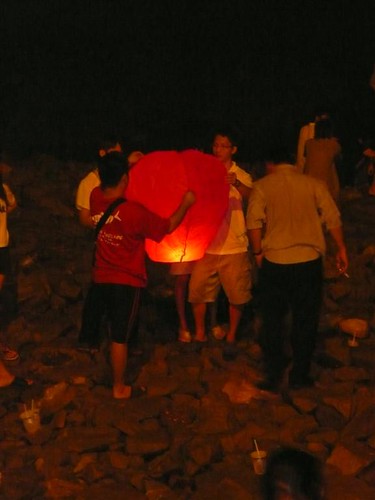
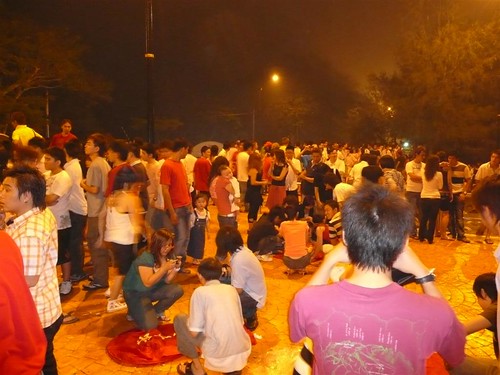
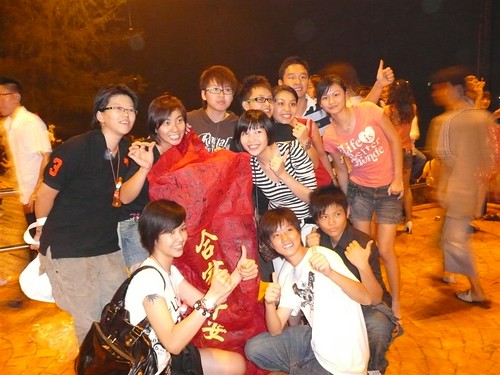
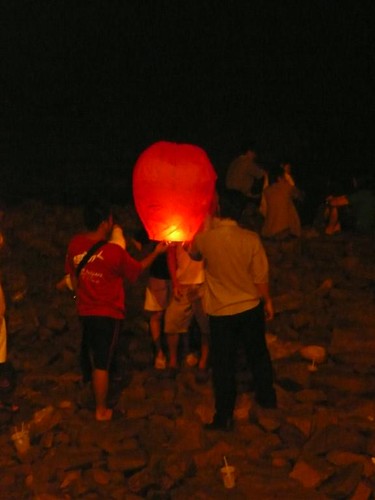
But the majority of the crowd were well behaved and were justenjoying themselves. Many of those who came in group will buy one of the lanterns and wrote their wishes down. Then, they launched it with much laughter. It was a pleasure even for those who watched.


There were many such groups celebrating the last day of Chinese New Year to end it with a great flourish.


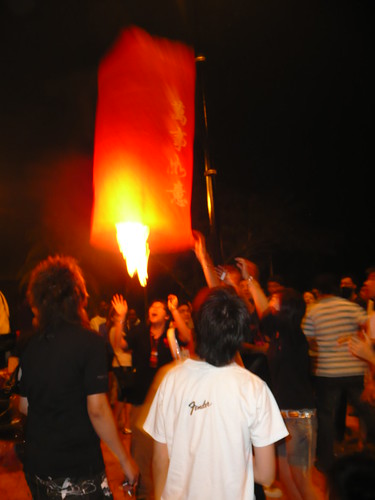
Groups after groups, almost non-stop sending off their lanterns.


The Kong Ming lanterns were a relatively recent introduction, maybe 5 years but not more than 10. Before that, no one in Malaysia and Singapore launches sky lanterns. I guess they were first introduced here by religious (Buddhist) orders. It was a good means of raising funds whereby donor buy the lanterns in the name of charity. They were originally all white in color. These days, it has become very commercialized and the favored color as least during the Chinese New Year period is red.


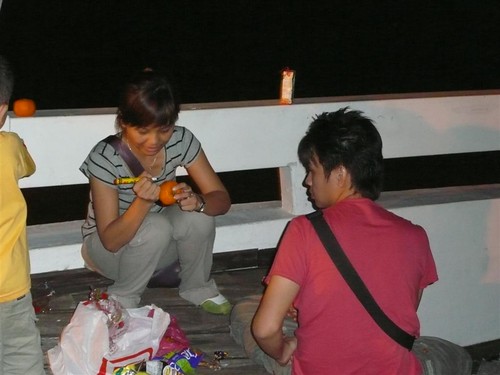
But where there any one throwing oranges? There were but not as many as expected which was a let-down given that this was the tradition on which the Chap Goh Meh was founded. Here is a girl writing down her wishes (telephone number?) on her orange before throwing it into the sea. There was also one new negative element which I dislike. There were people who went into the water to pick the oranges. Maybe they were curious and wanted to look at the messages which were an invasion of privacy. Surely, they did not want to eat them. There was even one guy with a fishing net. Sigh…


But even among joy, sadness and disappointment were never far away. This group of young boys and girls had set up their lanterns after happily written down their heartfelt wishes. They got together and prayed before letting go of their lantern.


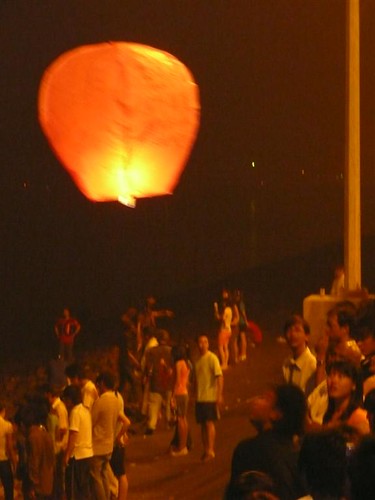
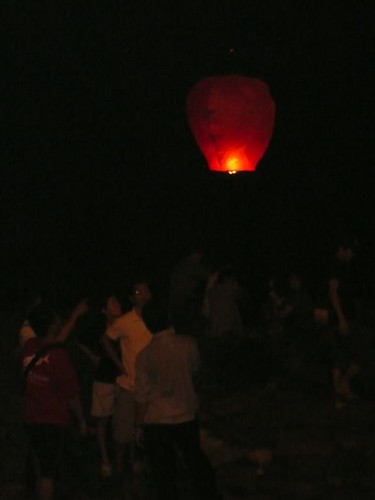
The minute they released it, off it went. With plenty of cheering and clapping and excited laughter. Their pleasures were contagious and their happiness rubbed on to the others watching. They cheered as it took off with vigor. Their wishes were bound to be fulfilled.


As it drifted off to sea, it drifted too close to the stone pillar. There were shouts of concern and frantic appeals. It brushed against the pillar, struggled and then lifted free off it. There were tremendous cheering and everyone were happy. But it was not to be a happy ending. When the paper lantern compressed against the pillar, the side caught fire. Even as it floated up, the sides burned. There were cries of dismay as the lantern burned and lost altitude. Then it lost height and dropped into the sea not far from the shore and sank.


The look on the youngsters' face told it all. There were great disappointments. And among the superstitious, they will wonder if this portend a bad year ahead. I shared in their disappointment but they were not the only lanterns that failed that night.


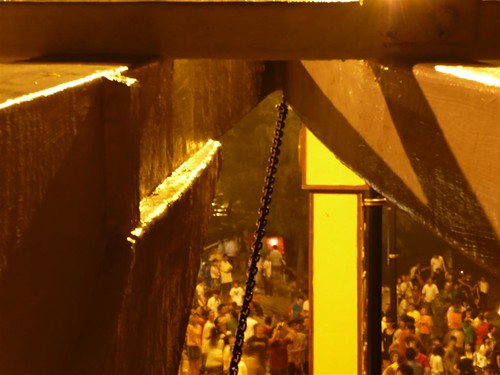
This was a shot I took from above the ship.


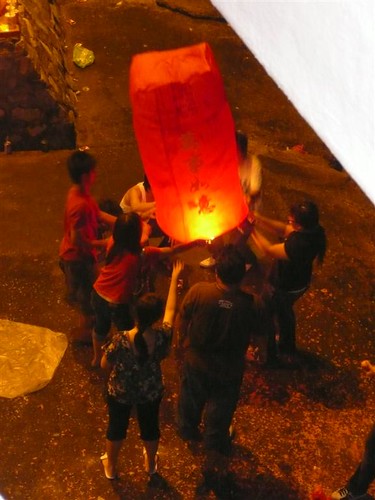
From there, I observed this family got together to launch their lantern. It was nice to see a family together in action.


They released it and off it sailed taking their wishes with them. Of all the launches I saw that night, this was my favorite.


Sunday, February 24, 2008

CNY: Chap Goh Meh #2 - Kong Ming Deng/Sky Lantern.


The most spectacular event in Tanjung Harapan is the almost continuous launching of sky lanterns called “Kong Ming Deng” or “Kong Ming Lantern”. Kong Ming is more popularly known as Zhuge Liang, the famous strategist of the “Period of the Three Kingdoms” (184AD – 280AD). It is said he used these sky lanterns to send signals to his troop. Whatever the truth, it is a fact that these lanterns came to be named after him. The original shape of the lantern is said to resemble the hat that he wore.


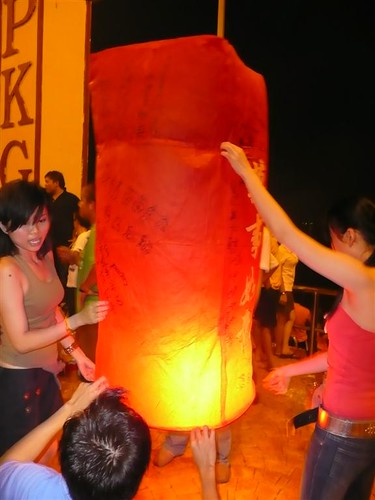
I saw three types of lanterns being sold on in Tanjung Harapan, two rounder versions and a taller style. The taller version costs RM30.00 which is a lot to be paid for something that can be constructed so cheaply. However, as no one fly a sky lantern alone, the cost per person is quite reasonable. The smaller and probably cheaper lanterns looked suspiciously liked they are made from plastic. If it is, then I think that is very bad as it only contribute to polluting the environment as these lanterns will eventually comes down. On hind sight, I should have checked but I was too busy taking photos to think about it. The correct materials should just be fire-proof paper, thin bamboo strips and a heating source.


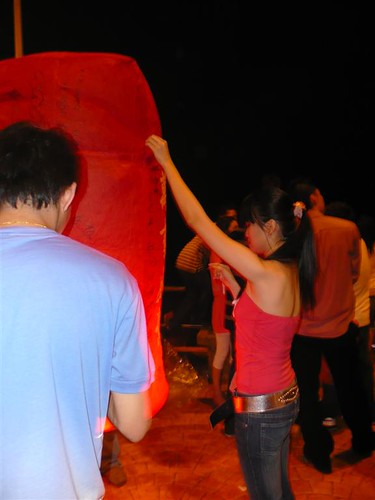
All who bought the lantern would scribbled down names and wishes on the lanterns before lighting it and sent it up to the sky praying their wishes will come true. Though almost all the lanterns took off successfully, there were a few failed ones that crash landed not far from the shore bringing cries of dismays. The tall lanterns took off the fastest while the rounded floated up more gently. The esplanade of Tanjung Harapan is ideal for launching the lanterns as a seaward bound breeze took these lanterns safely out to sea.


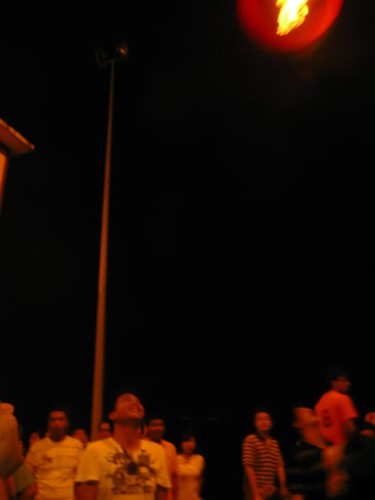
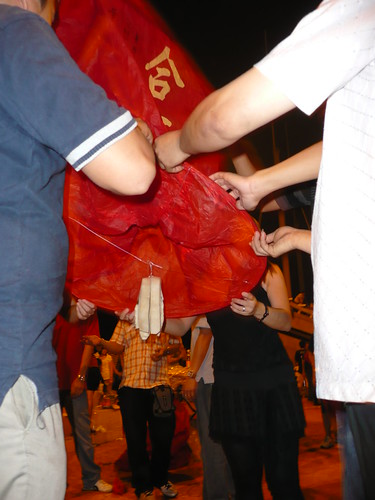
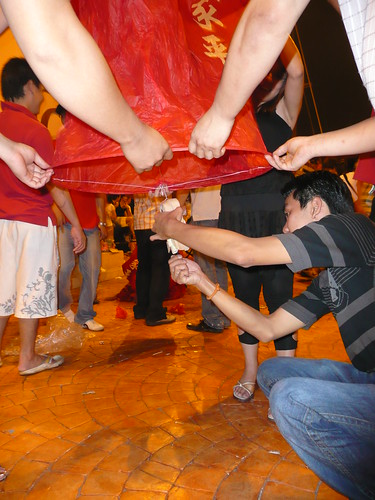
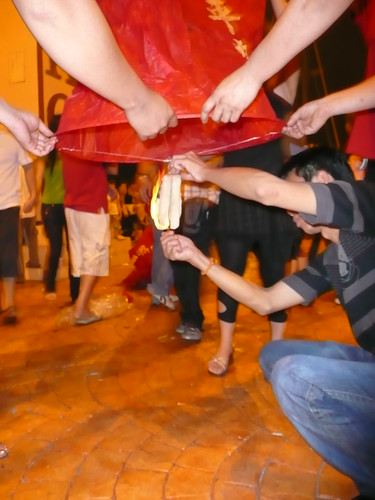
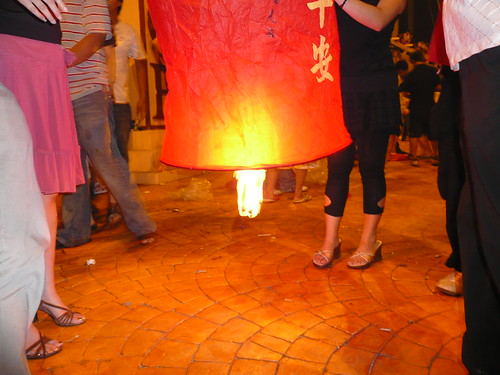
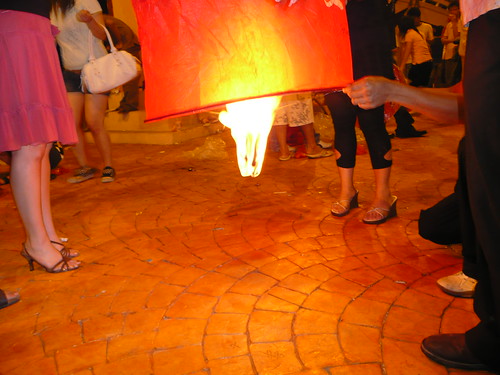
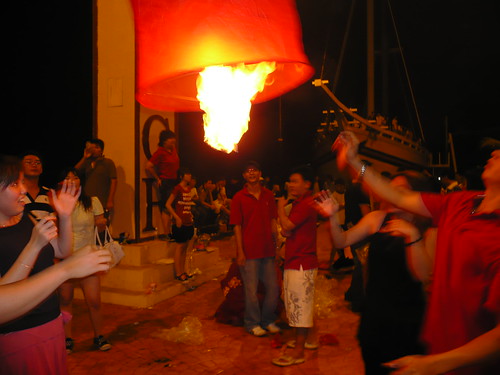
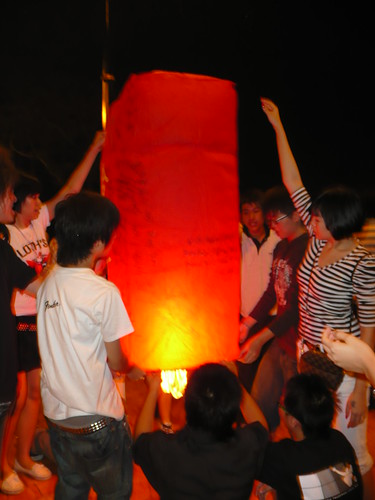
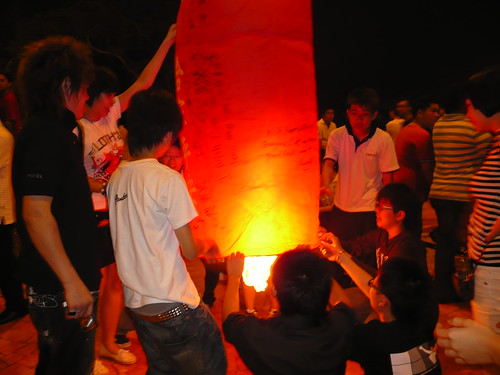
The following sequence will explain how the lanterns are launched –


To be continued...


Saturday, February 23, 2008

CNY: Chap Goh Meh #1 - In Pulau Ketam Jetty.


Chap Goh Meh or the Hokkien dialect for the 15th and last day of the Chinese New Year has been synonymous with a time honored tradition – the throwing of oranges into the sea. On this night, young, unmarried men and ladies will throng to the sea to throw fruits and made their wishes for a good mate. It was also an excuse for them to meet without the supervision of their parents for in the old old days, intermingling between the unmarried sexes were forbidden or at least frowned upon. Thus, the opportunities for to meet, ‘see’ prospective mates were limited. On that night, any young people who can get away will be there – and in the case of Port Klang, the old Pulau Ketam jetty in South Port which had been burned down (please refer in earlier articles ).


The reason orange is thrown is because it rhyme in Hokkien "Tim Kam Chua Ho Ang" (throw orange, get a good husband). For the males it is "Tim Peng Kor Chua Ho Bor" (throw apple, get a good wife). Later other nonsensical rhymes were also included such as "Tim Joi Tau Gei Ang Mor Lau" (throw stone, get a bungalow).


Both Kurau and me were old enough to remember the bustling activities in the jetty and had a somewhat naïve romantic memories of yesteryears. We had not been back there for a long time as much water had passed under the jetty since we both married. So it was there instead of West Port we went that night to document the event. We saw the jetty as -


lonely as this boat on still water. Our heart sank faster than the Titanic.


It is hard to describe the feelings we had. I will try to do it with pictures instead. It was like this man looking out to sea, waiting and waiting... under an orange spotlight that did nothing to illuminate except emphasized the darkness of the night.


It was as empty as this pathway that led to an emptier sea.


Like the reflections of these beautiful lights that shone for no one to see.


When we reached here, a full moon shone the way. Now dark clouds hid its view. Our feelings were similar to the cloud suffocated moon. Our hearts dropped like pins in a cavernous hall and I was sure I heard its echo. We lived through those times when this spot was the focal point of the town on this night. Now, it is was as empty as the hollow in our heart. We forced ourselves to take some photos and these are what you saw.


The only people who were there for the same reason was this young family but they only exacerbate our depressing state. We wanted to explain to them that it was not like this in the good old days. But we knew no matter how we explained, they will never see the scenes that we saw. And we were in no mood to explain anything.


And as I concentrated on taking some night shots, I did not realize that I was shot until much later in the forum. I always find it interesting to shoot other photographers when they are doing their things so I guess I cannot complain when this time round, I was the 'victim'. This is the only photograph of myself in my blogs for my writings are about the events and stories but not about myself directly and I meant to keep it that way. It was a very well taken photo which is why I included it here for it showed how forlorn the whole place was that night.

We looked at each other and knew that there is nothing more we can do here and decided to head to Tanjung Harapan though we knew that place will be jam packed. If I was alone, I may have lingered on a little while longer to commute with the ghosts of my past.


Next: Chap Goh Meh in Tanjung Harapan (Cape Hope).

To be continued...


Wednesday, February 20, 2008

A Visit To Dong Zen Temple 2008 - #3


As the evening deepened, the world took on a deeper shade and the sky reflected from the window is now a deeper blue. But they contrasted beautifully with the just lighted lanterns of yellow and red.


Even as I continued shooting, the blue deepened further. And the lanterns all appeared much brighter. As one world waned, another took its place and shined. The lanterns reflected from the window were interesting to me for they changed as I changed the angles with which to view them. Since I was in a spiritual place, I suddenly turned philosophical – “The windows are the same. The lanterns are the same. But how they appeared depends on how we choose to view them”. At that moment I had a sudden realisation, I will not have cut it as a philosopher.


But they sure looked different as I tilted my camera.


It is always interesting to watch other photographer at work. What did they see? What can I learned from them? And I couldn’t help wondering – did anyone see those lanterns on the windows as I saw? Did they see the same beauty?


The night approached to rule the world and the lights burst out to dispel the dark. Each is more beautiful because of the other.


I was not done with lanterns yet. They have a charm all their own. And a single lantern in a house can changed its entire mood. As it will if we walk down a deep wooded path on a night without moon. From the balcony of an upper floor, I took this shot with the lighted frame of the opposite building standing out against the black sheeted night.


So many angles were beautiful to me. Straight or slanting.


Close-up or far away. Single or a multitude. They are a pleasing sight.


While hanging from the roof, a gentle breeze blew. Gently swaying them just enough to lift some of their tails.


I walked out into the yard to view a golden Buddha sitting on a throne of lights so bright I have to turn my eyes away.


While a serene Goddess of Mercy continuously blessed all with an endless stream of holy water.


Another Buddha in a glass pagoda with changing colored lights.


As I walked away, the studious monk was still pointing the way to salvation. But I was walking the opposite way. The path was shown. But the choice is ours to make. I just hope that the different paths we choose leads to the same heaven.


Dragons in a roll spitting water.


But the images that lingered were that of the humble lanterns.


This lovely little horse followed me back home and now sat among my books in the glass drawer. And when asked, I told them I got it for free in Dong Zen Temple. If you would like to have one, visit the temple and look out for it. If it is in your karma, another little horse will follow you home.


Sunday, February 17, 2008

A Visit To Dong Zen Temple 2008 - #2


When you stepped into the main prayer hall, one may be surprised to find it brightly lighted with modern styling. The huge Buddha sat there serenely surveying the patrons who came visiting. There is little of the solemnity that one found in temple. On the other hand the glossy finishing and tiles lend an air of gaiety. May be too modern for some taste but I liked it as it is a depart from enforced gravity one usually find in places of worship. As anything in life, this also has disadvantages as will be pointed out later.


The story of the religion is beautifully engraved in the wall paneling as this fine example above. This order practiced Mahayana Buddhism.


A devoted couple on their knees paying tribute to Buddha.


A father teaching his children to pray.


Because the large brightly decorated open hall and very clean floor reduced the solemnity and gravity of the prayer hall, some of the visitors who are just here to look see did not behave as they should in a place of worship. They let their children ran about and loudly laughed while others were kneeling down and praying. Some even let their children roll on the floor. I was tempted to smack some of the - parents. This small boy volunteer tried with limited success to attract the attention of the more riotous visitors.


Many like me came for the photograph opportunity. There are always things to snap and I like catching photographers in their act. Here is on trying to find the perfect angle. For all I know, I have also been snapped.


A few devotees were very happy to have the chance to speak with one of the master. You can see the reverence in their facial expression and demeanor.


A thousand Buddhas.


There was an exhibition of the work of Feng ZiKai (1898 -1975). He was known as the founder of modern cartoons in China. His simple drawing of figures with Chinese cultural flavor is highly regarded. He is also a devoted Buddhist.


This is an example of his work.


There were also some beautifully crafted figurine of monks in various joyous pose celebrating life and happiness which is a joy to behold.


When I came out of the exhibition hall, the evening has deepened considerably and the lights are all switched on. However, it is not completely dark yet. In Malaysian weather pattern, this only last less than half an hour.


This was an outside shrine where devotees can make colorful candle offering to the Buddhas.


Join us for the next part - night scenes.


To be continued...

Saturday, February 16, 2008

A Visit To Dong Zen Temple 2008 - #1


The huge lantern is one of the highlight this year. Every year there are new highlights.


Almost every year I will try to make a trip to Jenjarom, a town on the way to Banting. There is sited the famous FGS Dong Zen Temple which has a floral and lantern festival celebration every year which offered many photo opportunities. FGS stands for Fo Guang Shan literally translated as Buddha’s Light Mountain which had its headquarter in Kaohsiung, Taiwan. Dong Zen on the other hand is an unusual English name. If adopted from Mandarin, it should be Dong Chan Si in its Romanized form. If translated, it should be Eastern Zen Temple. For some reason, half of the Mandarin Romanized and half of translated version were used resulting in Dong Zen Temple.


Source: FGS Dong Zen Temple.

This is the map showing how to get to Dong Zen Temple. There are still a few days left to catch the festival.


Source: FGS Dong Zen Temple.


This is the layout of the temple complex and the various activities within its compound.


This monk is pointing the way to enlightenment.

I did not pick an auspicious day to visit the temple. On the fifth day of Chinese New Year, 11 January, I decided to by myself as taking photos is an activity best done alone. As my car came to the head of the traffic light to turn to the road to Banting, I was stopped by a policeman. There were a couple of cars ahead of me. After a few minutes of waiting, I got out of the car to find what was going on and was dismayed to find that the “Tour De Langkawi” cyclists would be passing through this route. After waiting several minutes, and a massive jam building up, all the motorists were cursing because there were no cyclists in sight and if allowed to move, the cars would have been long gone from from this spot. Yet the policeman persisted in preventing anyone from going forward. Reasoning that even when the cyclist came, it will take a very long time to clear before the road would be made accessible for traveling, I squeezed my car out and took an alternative route.


One of the reason I visited every year is because of the large numbers and types of flowers on displays. This year is no exception.


It has been a long time since I came across Chinese playdough that are used to make various cartoon characters. You can either buy them outright or pay RM2.00 for a spin hoping to get the more expensive items.


A bag of fishes and tools of the trade.


Bushes shaped into the twelve animals of the Animal Years or also known as Chinese Zodiacs though I don't really like that term. See the visitors enjoying the flowers in the background.


These monks are sharing a joke with the stall owners. Always pleases me to see happy monks instead of serious ones.


You can buy wishes on which to hang on the branches of low wishing trees or buy a long red cloth tied to a string and tried to throw it up a tall wishing tree. Then pray to hope your wishes will come true for the year.


Pretty girl snapping wishes. She has one - to take a great shot. I also have one to capture her doing it. My wish came true.


This tree is laden with the wishes of patrons - a great burden to bear.


Red wishes swaying in the breeze. By the fifteen day, the tree may be more red than green.


I visited the koi pond every year.


But the fishes did not recognize me. Story of my life.

Another highlights of this year are miniature famous places of Buddhist worships in India. These are two fine examples.


This old sage with dreamy eyes looked at me and asked if I have found my way. I said I'm still as lost as ever. He said "stop looking". I smiled and replied that no disrespect but I've no intention to. I'm sure if he could lift his staff, he would brought it down on my blockhead.


To be continued...

Friday, February 15, 2008

Port Klang Views #3 - Along The Shore Of South Port, Port Klang.


Kurau said these will be extinct soon as modern shipping has no requirement of them. They were supposed to catch the ship's line for docking.


Cargo ship from Indonesia unloading goods. There are a number of such types of vessels plying the Straits of Malacca between Malaysia and Indonesia dealing mainly with the goods that are abundant in one country and not in the other.


These passengers were waiting to get on the board the jetty to Pulau Ketam (Crab Island). In the past, slow fishing boats used to be the means to get to that island.


A Ketam beauty looking on as a Ketam Big Size carried heavy box. Who do you want to be?


Kurau's kaki (members). He waved to them but then he waved to everyone. Some waved back. Others just gave him dirty look (he must have caught that fish they wanted).


These are definitely Kurau's kaki. A hat with sides that cover the sensitive ears, long sleeves, no sun block, no shelter, a little mad - had to be, under the hot afternoon sun waiting for a bite. I pity, Kurau empathy.


This ship won't be sailing anymore.


Whereas this rickety jetty looked like just about to topple over.


Piling is being done to build a new waterfront. Go there quick to have a last look at its untidy beauty. Soon you'll not see this anymore. You can see the Indian temple at the background.


Port Klang's Marine Department.

I apologize that the photos are not that very well taken from a speeding and when not moving rocking boat. No time to look for angles as the boat was constantly moving and scenery rapidly changing. Have to sit down or we'll topple over. Also need to keep hands steady as the boat cuts across water. Still, better something than nothing.


To be continued...

Monday, February 11, 2008

Port Klang Views #2 - The Old Pulau Ketam Jetty.


Kurau negotiated the sampan through the other boats.


He got onto his boat and attached the sampan to it. He then connected the petrol canister to the engine and got it started.


And drove his boat pulling along the sampan back to the shack to pick us up.


By now the tide has risen high enough for us to sail to sea and to those places too shallow to visit at low tide without worrying about getting stuck in the mud.


With a cigarette in his mouth, the cool sailor reversed through the crowded water to reach open sea.


This was all that remained of the old jetty. It was a very sorry sight for it was full of memories for me. I can still feel the crowd and hear the voices as they embarked and disembarked from the ships haunting me like old ghosts.


This is the ladder used to climb down to the lower floating platform to get onto the ferry.


When we were a teenager, practically the whole town will be here every Chap Goh Meh (the 15th days of Chinese New Year). All the young men and women of Port Klang will be down here to honor the tradition of throwing oranges and apples in the hope of getting a good mate. In the old days, not many people throw anything though we talked a lot about it. Apples and oranges are expensive! It was more to see the crowd (opposite sex) and to take in the cool evening breeze. We did nothing yet it seemed to be so much fun then. Now, this skeleton is all that is left of our memories. Before long, even this will be gone...


With the death of the old, a new jetty is born. You can see the crowd getting into the ferry in the new terminal in the extreme right of the picture.


These two concrete slopes also brought back memories. They were all that were left of the warehouses that temporary stored the catches from the sea before dealers came to collect them. They were sorted, boxed and iced here. The buildings are now gone. We are now in open water. We will be riding towards Bagan Hailam and the Yatch club in the direction of the bridge connecting North Port to the mainland.


To be continued...

Sunday, February 10, 2008

Port Klang Views #1 - The Journey Begins


(There were little written about the town Port Klang and now Klang where I lived in. They are also currently going through great changes that threatened to erase much of its past. Already much of it were already gone for good. I took it upon myself to do something to preserve its memory even if I could not preserve its history. I found a kindred spirit who shared my aspiration. I had met and known this new friend for only 2 months but had done more things together than with some decades old friend. He is a well-known figure among the fishing community and they called him KurauKing. He too was born in Port Klang and now staying just a few blocks away from my current house. Kurau owned a boat but more important, he knows the sea like the back of his hand.

Together, we can do things neither of us can do well enough alone. We started with the "The Sultan Abdul Aziz Gallery", "Death Of A Town Called Perlama" and then proceeded to "Sunset Over Railway Bridge". These had already been posted, if you want to read them, click on the links. Now, we cover part of the South Port and West Port of Port Klang. Port Klang is actually made of 3 ports, South, North and West (in chronological order of their construction). Ours is not a scholarly study but a human one with memories of our youth and our reflections intersperse with descriptions of the space we visit and revisit. We hope to take you with us in our journey and hope you enjoy it as much as we do. Should any readers have anything to add, we welcome your comments here or to send me a private mail. This journey had already begun in MyKlang forum where we shared with our community. I decided to put it up in my blog to share it with the rest of you. It is also posted in Kurau's website, you can play a visit there as well or wait for it to come out in increment here. As it was written in forum style, it is very informal and less structured and I had chosen to retain that with minimal editing and addition.)


This is my town -


When the forum members met recently, we realized that some were either not from this part or were not born yet when the changes swept through the town. Others may have not seen the town as we have seen it. And it is changing so fast that many old landmarks are now gone, disappeared forever from sight and soon from memories as well. Kurau & me thought we will try to document as many places of interests in Klang/Port Klang as we can to give our town some history before they are forgotten. We need your help. Please share with us your experiences, insights, memories so that the tapestries will be richer as more weave their tales into them. If you do not want to do it here, please email, private message, call us or we can meet over tea to hear your story. We volunteer ourselves to make a start but we rather this to be a joint effort with all members contributing.


Perlama was a start. Now we continue with views of South Port and West Port from the sea as some of you may not have seen it from that angle. Kurau was kind to contribute his boat and time for this effort. Hope you enjoy it and be free to use it to promote our town and share it with friends.


This shack housed the "Persatuan Pemancing Klang" (Klang Fishing Association). This is just a temporary building. All the buildings along this stretch of the waterfront front were torn down to be replaced with a new waterfront. So this hut was put up so that their members can at least have easy access to the sea.


It was just after 3.30pm and the tide was just coming in. You can see the pillars of the old jetty that was burnt a number of years back.


On our left is the building which housed the new jetty to Pulau Ketam. The vacant building just before it used to be a 3 storeys building with a coffeeshop on ground floor which served an excellent curry laksa. The upper floors were used for a Chinese restaurant called "Port View". For many years, that used to be a landmark itself. It was the best and most famous restaurant in town and ran by Hainanese owners and cooks. I had countless wedding dinners in that restaurant. On the first floor was an entire wall with a lovely picture of a naked lady made entirely of glossy mosaics. In my entire years of traveling, I had not seen another such picture. It is such a pity I don't have a picture to show. Anyone who had a shot? A rather strange design for a Chinese restaurant but not so strange, because this place were as much frequented by sailors and seafarers from all over the world who arrived by ship as by locals. Alas, the restaurant and its uniqueness were all gone replaced by empty land for many years now.


The jetty to Pulau Ketam (Crab Island).


If you take the main road (Persiaran Raja Muda) of Port Klang, and traveled along it you'll come to the sea which is where the jetty is. There is the LRT station which is the last stop. This view is looking back at that road where we come from. The LRT station is now on the left. The train you see in the picture is carrying containers from North Port through South Port to West Port.


Kurau King carrying petrol for his boat. We had earlier pumped in the petrol in one of the station and carried it in his proton (not the “beemer”) for it stank of petrol all the way.


The water is now coming in quite fast. It should be enough to allow us to sail but first we must retrieve Kurau's boat.


This is the view of the new Pulau Ketam jetty which you will be taking if you want to go to Pulau Ketam.


Kurau's boat is the white boat at the far end. Since we cannot walk on water, he'll have to find a way to reach it.


He went to retrieve this small boat (blue color) which is the water taxi to reach his boat. It is usually tied to the shack so that everyone can make us of it as this place does not have a proper jetty for you to anchor your boat. Everyone chipped in to maintain this boat for the benefit of all. A true “Gotong-royong” (neighborhood/co-operative) spirit. (Another new friend who joined us that day was EK Wong, an accountant by profession who can drink like a fish.)


Friday, February 8, 2008

Happy Chinese New Year - A Visit To Thean Hou Temple.


Things were a little different for me this year. I moved to a new house. All my children have finished their schooling. I made many new friends and lost some old ones. Some in rather painful manners. Whichever ways I felt about it, I had to move on. I visited friends in their house this year. Something I had not done for many years. I went for the movies. After Stephen Chow's latest - CJ7 which to me was more of a disappointment especially as I loved "Kung Fu Hustle", we decided to make the trip to KL to visit Thean Hou Temple.


It seemed many people also have the same idea. The place was jam packed and it was difficult to find a parking space. After a few rounds on bad earth road, managed to squeeze into one corner and quickly went to snap a few shots.


In the playground in front of the temple, lighted lanterns of animals and plants were all over it and the children were having a great time.


This is the rat year and the rat took center stage with a huge several storey high standing in front of the temple welcoming patrons and the New Year. There were also lanterns of all the other animals of the Animal Years.


This year the whole places were decorated with lanterns and they were a pretty sight. There were too many people to take good pictures. No place to stand and frame good angles. No place to place my camera for night shots. Wished there were not so many people. Wished I had my tripod with me. Wished I had more time. Wished I had more space to frame my shots. Wished for a lot of things. Ha ha. But we make do with what we have. So these are the best I could do under the circumstances.


There were many people blocking my views and I did not want to remove my shoe to go into the temple. I didn't even know whether we are allowed to take picture inside. So I stood far away with a multitude of people between me and The Empress of Heaven. I stood there patiently and waited till a slight gush of wind lifted the tail of the lantern to allow me to take this short of the serene image of Her Royal Highness. May not be a great shot but it will be a good memory.


Lanterns were everywhere and the people under it are bathed in a reddish light.


I climbed to the highest level and managed to squeeze a tiny space and religiously guard it to take the night shots of the KL towers and the Petronas Twin Towers towering over the KL city skyline.


My phone rang. The friends I was with wanted to go home. Some of them had stayed until early morning to play Mah Jong and were tired out. Wished I had more time. But often we just have to grab what we were given and glad that we at least had that chance. Even if it was not enough. When was ever good time enough? Think I ought to remember that for the rest of the year.


Tuesday, February 5, 2008

Koto: Traditional Japanese Stringed Musical Instrument - II


Since I knew about its activities, I follow The Japan Foundation’s activities closely and try to make it for those programs that I am interested in. So when I learned that the Koto Festival was in town, I was very keen to attend. The event was held in Dewan Auditorium Tunku Abdul Rahman in the Malaysia Tourism Centre. I tried to get the free tickets before going there from Port Klang but they could not reserve the tickets for me so I have to take my chances.


It was not good for on that Friday evening, 30 November as we were caught in a very bad traffic jam. We were sure we were going to miss it or the tickets would be long gone by the time we reached there. We arrived around 8.00 pm, rushed to the hall and to our pleasant surprise, there were still tickets available. We had a quick meal in the nearest restaurant and settled in for the show.


I was not familiar with Koto music and did not know what to expect. Sawai Kazue is a diminutive lady full of bubbling energy. And when she poised over her koto, we saw a master over her instruments and we waited anxiously for the first note. When she plucked the string, the koto screamed. It screeched and groaned. It moaned and gave out frightening cries. The minute the first note was struck, the vibration echoed from the hollow cavity and gripped our heart. The shrieks tore at us and distressed us with the harsh discordant sounds. We were stunned for this stringed instrument that looked so much like a Guzheng sounded nothing like its melodious notes floating on air. They were harsh, sharp notes that rend and tore. We sat there arrested by its raw power that seized us. If music is sound that that touches your soul, then this is music but it is unlike any music I knew. It distressed yet we took pleasure in that it could move so.


I loved it but at the same time I was disturbed by it. I thought music soothes. Lured you to a reflective mood, put you into a dreamy state, envelope and intoxicate you with its melody. Koto music shook you up violently from your slumber, slapped you to get your attention, and petition you to hear their grievances. I used to think that Erhu is the saddest sounding musical instrument. Maybe it is still is to me. Mournful may be a better word. It is like a man mourning the death of his lover. The sorrow feels like constant weight shifting on the heart. But the Koto is like a mother screaming at the death of her child. The pain searing as if the heart is cracking under the strains of unbearable sorrow. I love it for its intensity but it is a disturbing intensity.


Sawai Kazue played Yatshuhashi Kengyo’s “Rokudan no Shirabe” (Study in Six Steps) as her first piece with her 13 strings koto and introduced me to an instrument that produced individual harrowing notes that somehow combined to a musical rendition which is highly affecting. As it played on, I began to recognize some of its typical notes that formed the unique characteristics of Japanese music, only I didn’t know before that it came from Koto. While most stringed musical instruments flows and merges (and Koto also do the same), its most typical emphasis is in its emphatic prodding steps like the highly dramatic movement of Japanese dance. Maybe one inspires the other?


In the middle of the first performance, the string broke. In Chinese romantic or kung fu movies, someone just died. This pint sized lady sprung up, laughing gaily at the same time apologizing profusely explaining that this is not a rare occurrence. I love her exuberance, I love her attitude, I love her professionalism, her passion, I love her. In fact they had brought along an instrument master for the sole purpose of repairing, stringing and tuning it. In typically Japanese fashion, the shy master with white gloves declined to string the koto on stage despite appeals from the players and audience. With that done, the performance continued.


The second performance involved the whole ensemble and the softer sound of the 17 strings koto combines making it sound more ‘musical’ and more akin to what our ears were accustomed with. But when the 13 strings played, it provided a keen distinction and sliced through these melodies swifter than a hot knife through soft butter. And I found myself looking forward to its “sharp discordant sound” that cuts like a knife. “Genka” which means “playing the koto, and singing at the same time” is a conversation piece between the sweet 17s and shrill 13. Beautiful.


“Dosei” is about two different voices from the earth, the sound of wood (koto) and song of the bamboo (shakuhachi, a end-blown flute). Wood spoke with its earthly voice, deep, hoarse and ancient. Bamboo sang through the woods riding on the wing of the wind that rustles through its leaves. Sawai Hiraku played the koto while Motonaga Hiromu blew the shakuhachi. Maybe it was because of the piece or was it because of the softer note of the 17 strings, I was not hit with the explosive force of her mother’s performance. I liked the hollow vibrating song of the flute better. What I liked was Hidaru’s playful pushing of his hips at the end of the performance to acknowledge the crowd’s applause. A most uncharacteristic gesture of a master of traditional instrument.


And when the haunting cry of the flute sounding like a lone wolf howling to the moon combined with the raw power of the Sawai Kazue’s amazing talent, it was as if we were transported back to the time when the ancients prayed to the mysterious moon in “Jogen no Kyoku”. What a splendid performance!


Two Malaysian songs – “Dimanakan Kucari Ganti” and “Getaran Jiwa” was played with koto. It was interesting, even amusing but I was thrilled by it as when the Japanese songs were played. This is because I believe music was composed with the musical instruments and musical culture of the land in mind. Quaint would be the word I used. It was entertaining but nothing more.


The final act “Futatsu no Gun no Tameni” showed the wonderful range and versatility of the 13 and 17 strings koto. It mixed and blend like a boisterous crowd, together and yet apart. Every now and then, a singular will raise above the din and made its distinctive sound heard above it. In this performance, we heard what the koto are capable of, from flighty steps to wavering warbles. I would have thought this was the best koto can provide had I not heard Sawai Kazue’s solo performance.


The night ended too fast.


We were invited onstage to ‘play’ with the koto. It was a little surprising to me and greatly appreciated that these musicians allowed us mortal to touch and play with their prized instruments. Looking now at the tender affection these musicians showed and explained to us uninitiated, I could help but think what a contrast they showed when they were coaxing the instruments to produce the sound they want. Unlike Guzhen players that seemed to gently draw out the sounds, the koto players seemed to torture it out of their. They compel it out with a surprising passionate violence. They plucked at it with force, beat it, pulled it and you feel like they are squeezing it out from a reluctant uncooperative partner. I am sure they loved it but it sure looked like a strange love to me.


Among all these angels in fairy dresses, I could easily lose my heart. But if I were to be given the choice of spending a day with one of them, without hesitation I would choose to spend it with Kawai Kazue.


Saturday, February 2, 2008

Koto: Traditional Japanese Stringed Musical Instrument - I


Source: Koto World

The Koto is a traditional Japanese stringed instrument derived from the Chinese Guqins. It is a long, hollow instrument about six feet (180cm) long carved from Paulownia wood which is also known as the Empress Tree. Its shape is said to resemble the dragon and the various parts of the koto are named as various parts of the dragon. 13 strings are strung across the length of the instrument. Underneath the body are two holes to produce its instinctive sounds in the cavity of the hollowed wood.


Source: Wikipedia

Players adjust the pitch of the string by moving the bridge along the length of the koto. The sound is created by plucking the string with three finger picks that are worn on the thumb, forefinger and middle finger. The player kneels towards the right end of the instrument which is the head of the dragon. The left hand is used to altered the sound in various ways such pressing the strings firmly to the left of the bridge to change the pitch or to move gently over them to create a vibrating sound.


Yatsuhashi Kengyo (1614-1685), a gifted blind musician from Kyoto transformed koto by innovating it with new techniques, new composition and new tuning and became known as the “Father of Modern Koto”. His most famous composition "Rokudan no Shirabe " (Study in Six Steps) remains the most well-known koto piece and viewed by koto players as containing all the basic techniques of koto playing. Today, visitors to Kyoto can even enjoy “Yatsuhashi Sembei”, a special koto shape cookie.


The Japan Foundation in December organized a Koto music concert in December last year to introduce Koto music to Malaysian. Sawai Koto Orchestra, one of the best koto ensemble was brought over to perform. The main performer is Sawai Kazue who together with her husband, Sawai Tadao founded the Sawai Koto Academy.


She is joined by her son Sawai Hikaru, who interestingly is also founder of the rock band “Mephisto Pheles”. It is rare to find someone with both the talent and inclination for rock as well as traditional Japanese instruments. He is still active in both fields.


Next post: My first personal experience of live Japanese Koto music.


Friday, February 1, 2008

Sunset Over Railway Bridge - III


These set of pictures was taken on a different days from the earlier set. It was the end of a bright sunny afternoon but there was still significant cloud covers. That day, the tide was low but the hot afternoon ends with a glorious orange that painted the entire scenes in gold. The atmosphere and mood was very different. It was a working day and I knocked off from work a little early to capture some shots as I promised a friend to send her some pictures of a Malaysian sunset from my hometown and I couldn’t chosen a better evening. The above picture showed the sun rays reflecting on the arch of the railway bridge.


This is the romantic view of the river opening out to the receiving sea. The subdued tone played on the mood and it was easy for one to lose his thoughts to the gentle scene. Nothing stirred. It was as if the scene was frozen in time.


But that was broken by a small boat breaking the calm surface chugging its way home.


The waves it created lapped the shore and a few minutes later, all was still again. As if no boat had just passed and that it was all in the imagination.


I turned my attention to the upstream and looked at the fishing village basked by the golden rays.


Further up the river was the restaurant that we used to frequent and from where you can have a good view of the railway bridge. The red wooden building on stilts looked most impressive at this time of the day.


The sun is just about to sink below the tree lines. The world took on a deepened tone and the approaching dusk is encroaching to claim it for the night. Birds are now dotting the sky flying back to their nest and insects calls started to increase both its frequency and intensity. I waited until it was almost completely dark before I walked on railway tracks to reach my car parked in an empty field. I always have melancholy thoughts viewing the sunset but it is of the enriching kind as I got in touch with my inner self. They are not depressive or mopping thoughts that sapped energy. I release any headache or heartache I may have to gently sink with setting suns.


The End.